Weed Control in Wheat – Effective Methods and Solutions
Weed control in wheat is a topic that concerns literally every cereal producer in Bulgaria. Weeds are wheat's main competitors for water, light and nutrients. Without effective control they can reduce yields by 20–40%, and in some cases even more. In this article we will look at the most widespread weeds in wheat crops, the optimal timing and methods for controlling them, and how modern spraying technologies can increase the effectiveness of treatments.
Why Weeds Are So Dangerous for Wheat
Weeds don't simply "stand around" – they actively compete with wheat and cause damage in several ways:
- They take nutrients – especially nitrogen, which is key for wheat yield
- They compete for water – critical in the dry areas of Bulgaria
- They shade the crop – reducing photosynthesis and slowing development
- They spread diseases and pests – some weeds are hosts for pathogens
- They hinder harvest – green weeds increase grain moisture and cause losses
- They contaminate produce – weed seeds in the grain lower quality and purchase price
Research shows that every 10% infestation of wheat areas reduces yield by approximately 5–8%. In the case of heavy infestation, losses become catastrophic.
Most Widespread Weeds in Wheat in Bulgaria
Grass (Monocot) Weeds
Wild Oat (Avena fatua)
Wild oat is one of the most dangerous grass weeds in wheat crops. It is extremely competitive, as it is biologically close to wheat and occupies a similar ecological niche.
Characteristics:
- Powerful root system competing with wheat for water
- Seeds ripen before harvest and scatter into the soil
- Can maintain viability in soil for up to 7–8 years
- Difficult to distinguish from wheat in early stages
Ryegrass (Lolium spp.)
Ryegrass, especially Lolium rigidum, is a growing problem in Bulgarian agriculture. It is characterised by:
- Rapid development and high competitiveness
- Development of herbicide resistance – a serious problem worldwide
- Large seed production – one plant produces up to 10,000 seeds
Loose Silky-Bent (Apera spica-venti)
This is a mass weed in Northern Bulgaria:
- Prefers wetter conditions
- Highly competitive at dense populations
- Seeds spread easily by wind
Broad-Leaved (Dicot) Weeds
Mayweed (Matricaria spp.)
Mayweed (scentless and scented) is a ubiquitous weed in wheat fields:
- Branching plants with many shoots
- Mass seed production
- Sensitive to most broad-leaved herbicides, but difficult to control when treated late
Field Poppy (Papaver rhoeas)
The field poppy is beautiful but unwelcome in wheat:
- One plant produces up to 50,000 seeds
- Seeds maintain viability in soil for decades
- Developing resistance to ALS-inhibiting herbicides in some areas
Speedwell (Veronica spp.)
- Appears en masse during wet autumn and winter
- Flowers and seeds early
- Competes with wheat in the earliest phases
Charlock (Sinapis arvensis) and Wild Radish (Raphanus raphanistrum)
- Tall and competitive cruciferous weeds
- A single plant can reduce yield in a radius of 30–50 cm
Optimal Timing for Herbicide Treatment
The effectiveness of weed control depends critically on the timing of treatment. A detailed calendar for all treatments can be found in our article on when to spray wheat.
Autumn Treatment (After Emergence)
When: November – December (at temperatures above 5 °C)
Autumn herbicide treatment is effective against overwintering broad-leaved weeds that emerge together with wheat:
- Suitable against: mayweed, poppy, speedwell, chickweed
- Advantage: weeds are in early stages and easily destroyed
- Limitation: does not effectively control spring weeds and grass weeds
Spring Treatment – Main Window
When: end of February – mid-April (tillering stage, BBCH 21–29)
In the Thracian Plain – the Plovdiv, Pazardzhik, Stara Zagora and Haskovo areas – spring herbicide treatment usually begins at the end of February. In Dobrudzha and Northern Bulgaria the optimal window opens 2–3 weeks later. This is the most important period for weed control in wheat. In this stage:
- The wheat is hardy enough to tolerate the herbicide
- Both grass and broad-leaved weeds are in sensitive early stages
- Temperatures allow preparations to act effectively
Optimal temperature: 8–20 °C. At temperatures below 5 °C herbicides act slowly. At temperatures above 25 °C the risk of phytotoxicity increases.
Late Spring Treatment
When: April – beginning of May (stem elongation phase)
In this phase herbicide treatment is risky and is used as a last resort:
- Only with products registered for late application
- Increased risk of phytotoxicity and ear deformation
- Broad-leaved weeds are already at an advanced stage and harder to control
Types of Herbicides for Wheat
Against Broad-Leaved Weeds
| Type | Active substances (examples) | Spectrum | | -------------------- | ------------------------------- | --------------------------- | | Sulphonyl urea (ALS) | Tribenuron-methyl, mesosulfuron | Broad spectrum broad-leaved | | Hormonal | 2,4-D, dicamba, fluroxypyr | Resistant broad-leaved | | Combined | Amidosulfuron + iodosulfuron | Maximum spectrum |
Recommendation: Use combined products or tank mixes for maximum spectrum. When there is a problem with poppy and mayweed resistant to ALS-inhibitors, add a hormonal component.
Against Grass Weeds
| Type | Active substances (examples) | Target weeds | | ----------------------- | ---------------------------- | -------------------------- | | ACCase inhibitors (FOP) | Fenoxaprop, clodinafop | Wild oat, ryegrass | | ACCase inhibitors (DEN) | Pinoxaden | Ryegrass, loose silky-bent | | ALS inhibitors | Pyroxsulam, mesosulfuron | Broad spectrum grass weeds |
Important about resistance: Rotate mechanisms of action! If you use the same type of herbicide every year, weeds develop resistance. The poor control of ryegrass in Europe is a direct result of excessive use of ALS inhibitors.
Integrated Approach to Weed Control
Herbicides are the main instrument, but not the only one. The integrated approach includes:
Agrotechnical Measures
- Crop rotation – alternating with row crops reduces the seed bank of weeds in the soil
- Correct seeding rate – denser crops compete with weeds more effectively
- Timely sowing – the optimal sowing date gives wheat an advantage
- Selection of competitive varieties – varieties with rapid early development suppress weeds
Mechanical Control
- Pre-sowing cultivation to stimulate weed germination
- Post-harvest stubble cultivation to reduce the seed bank
Chemical Control with Maximum Effectiveness
This is where the role of precision application comes in. Even the best herbicide is useless if it doesn't reach the target, at the right dose and with the right coverage.
How the Drone Improves Weed Control
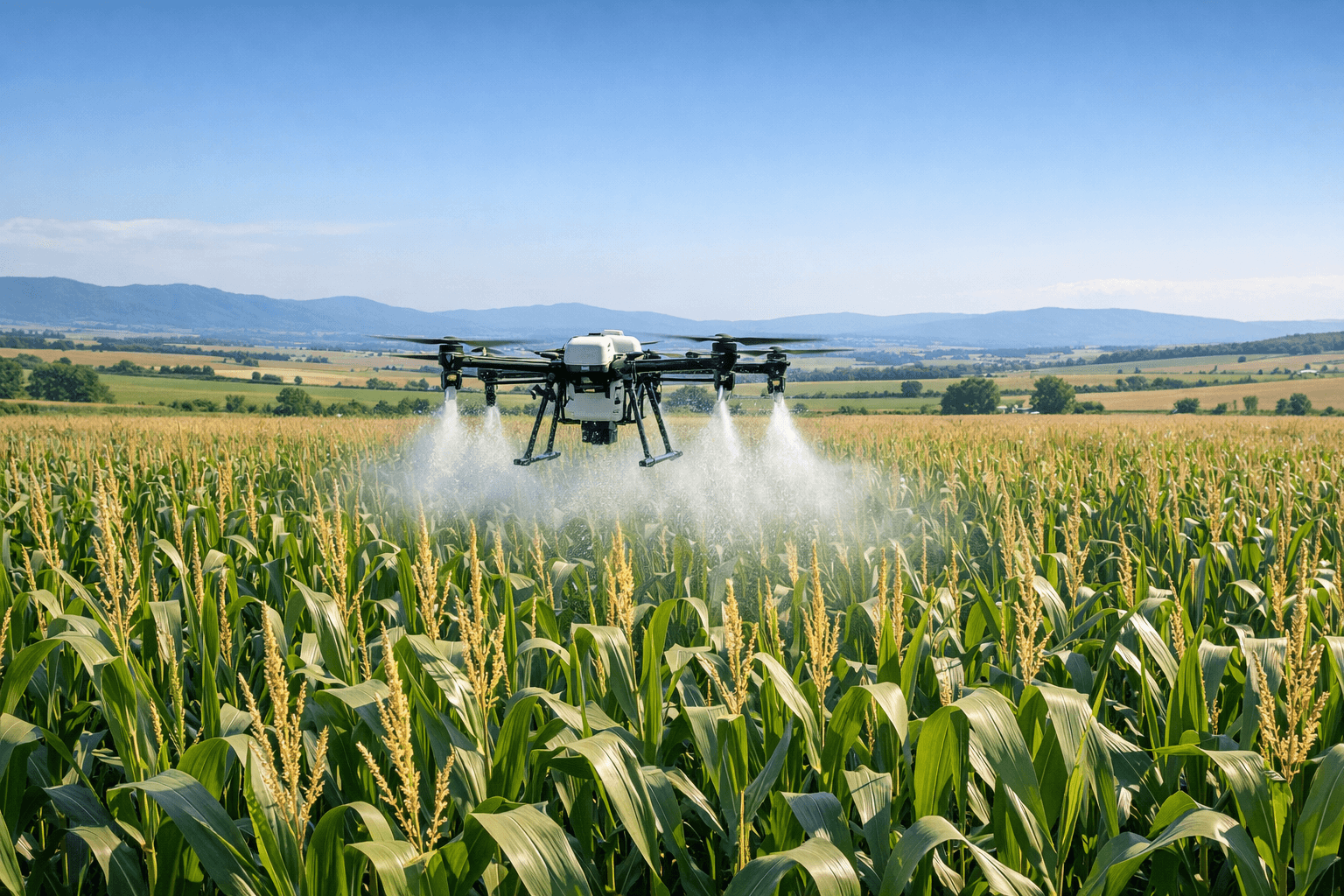
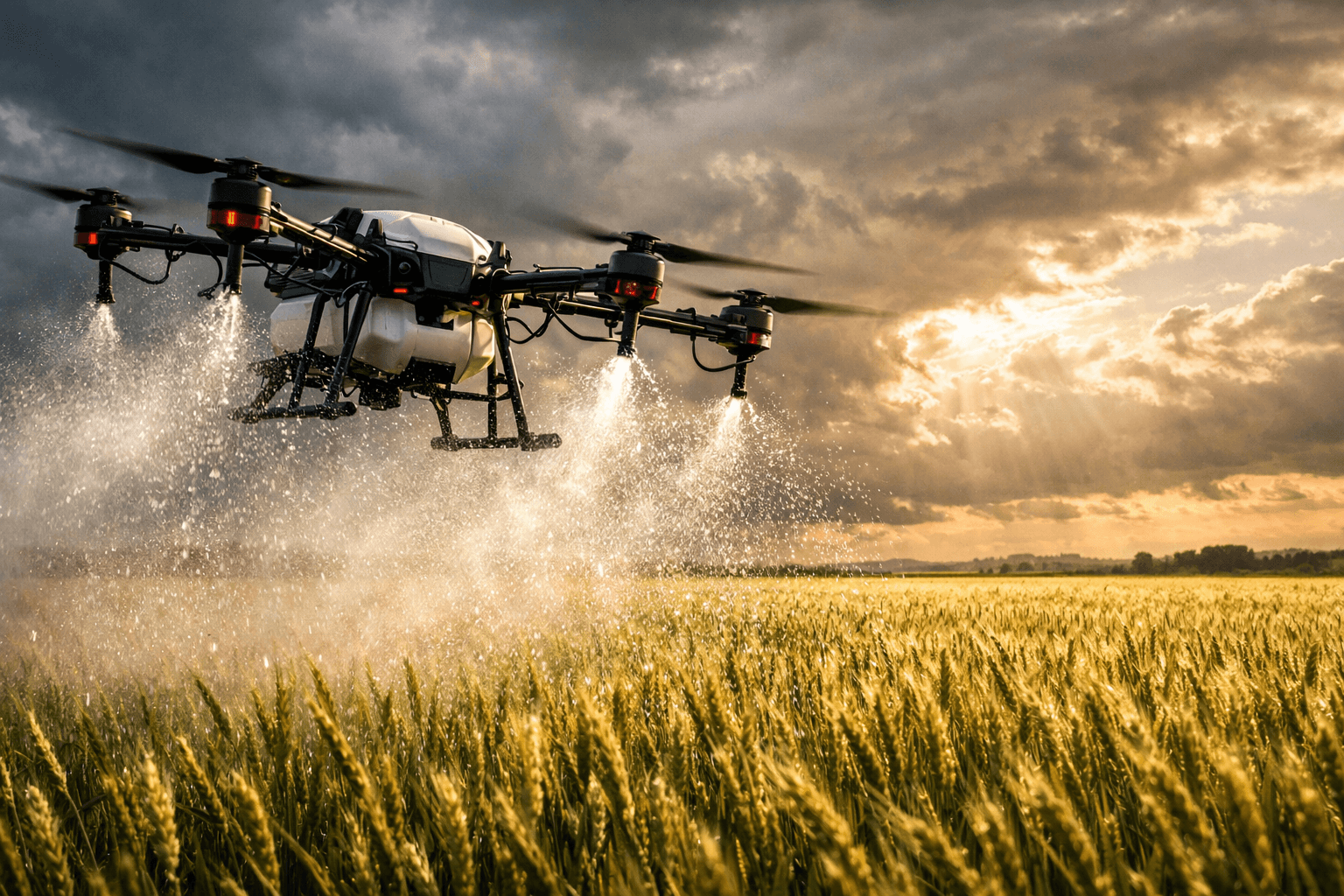
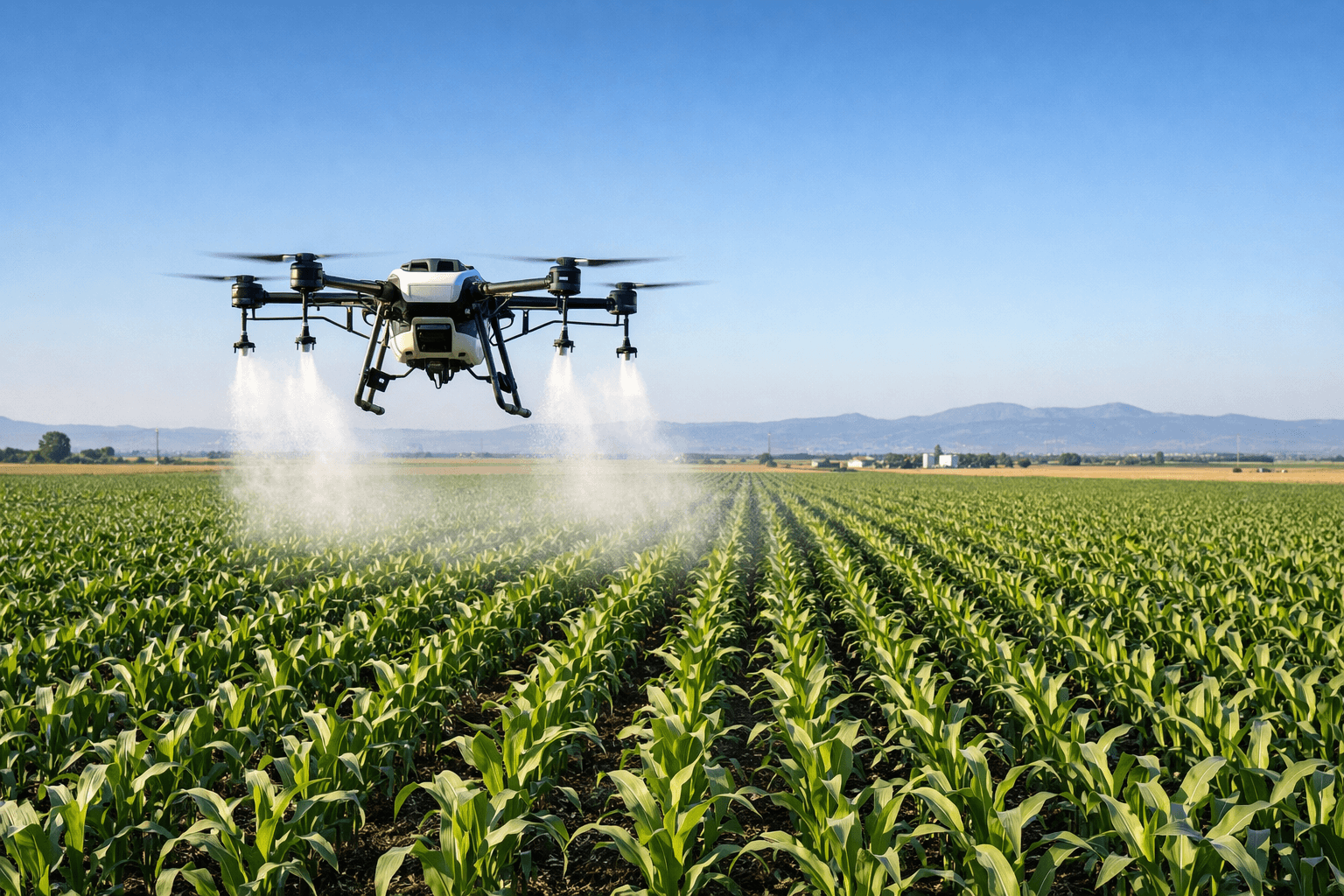
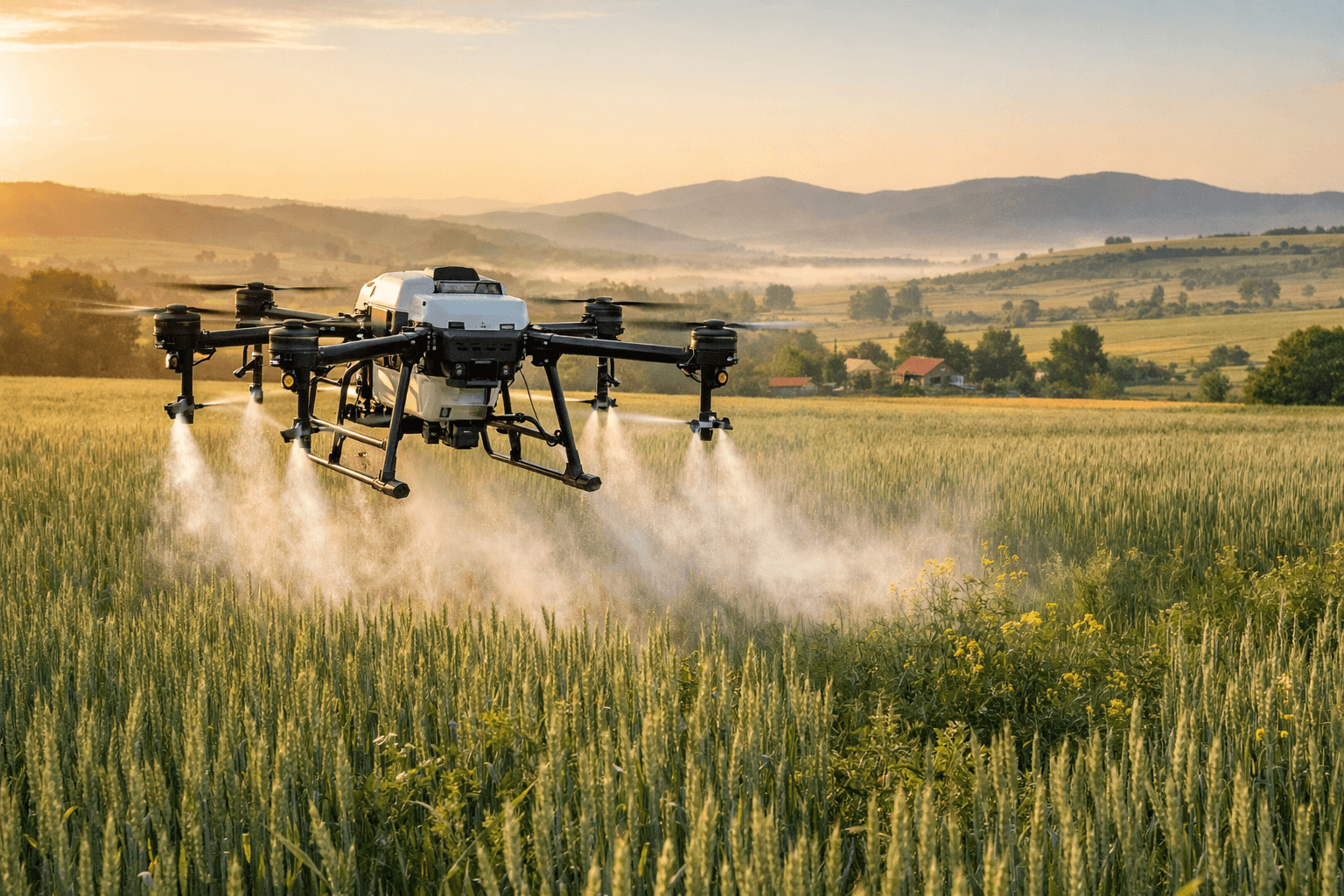
Herbicide treatment effectiveness depends on three factors: correct product, correct timing and correct application. For the third factor, the DJI Agras T50 drone provides significant advantages.
Uniform Coverage without Gaps
GPS navigation and automatic flow control guarantee that every square metre receives an equal dose of herbicide. With ground spraying, uneven terrain, changes in speed and turning inaccuracies lead to zones of overdosing and zones with gaps – it is precisely in the gaps that weeds survive.
Precision Application at Low Volume
The drone works at ultra-low volumes (1–3 L/dka solution), which means:
- Less water – easier logistics
- More concentrated solution – better leaf surface coverage
- Up to 30% saving on preparation with the same effect
No Crop Trampling
In early spring, when herbicide treatment is carried out, the soil is often wet. Heavy ground machinery tramples the soil and runs over wheat plants in the tracks. Losses from trampling are estimated at 5–8% of yield. The drone eliminates this problem entirely.
Speed of Action
The DJI Agras T50 treats up to 200 decares per hour. This means you can treat the entire area within the optimal window, instead of losing days or waiting for the soil to dry.
For more information, see how wheat drone spraying is carried out and our drone spraying services.
Weed Control Programme for Wheat – Example Plan
Option 1: Standard situation
- Spring treatment with a combined herbicide (ALS + hormonal) – tillering stage
- If needed – grass herbicide together or separately
Option 2: Heavy infestation (grass + broad-leaved)
- Autumn treatment with broad-leaved herbicide – November
- Spring treatment with grass herbicide – March
- Additional treatment with broad-leaved herbicide (if necessary)
Option 3: Problem with resistant ryegrass
- Pre-sowing cultivation – stimulate germination and destroy
- Herbicide with a different mechanism of action (not ALS) – tillering stage
- Increased seeding rate for better competition
Common Mistakes in Weed Control
- Treatment too late – weeds have already caused damage and are more resistant
- Spraying in unsuitable conditions – wind, cold or heat reduce effect
- Insufficient dose – "for economy" the dose is reduced, but weeds survive and develop resistance
- Same herbicides every year – the surest path to resistance
- Incorrectly calibrated sprayer – leads to uneven coverage
- Neglecting agrotechnology – herbicide is not a panacea; without crop rotation problems grow
Frequently Asked Questions
Can I mix herbicide with fungicide? Yes, for many combinations this is possible and even recommended to save time. But always check the compatibility of the specific products. Incompatible mixing can reduce effect or cause phytotoxicity.
What should I do if I miss the optimal timing? Consult an agronomist. In some cases late treatment is better than none, but the risk of phytotoxicity must be assessed. Learn more about optimal timing and fungicide spraying of wheat so you don't miss subsequent treatments.
How much does drone spraying for herbicide treatment cost? Prices depend on the area and specific service. See current information on drone spraying prices.
Conclusion
Effective weed control in wheat is a complex task that requires knowledge of the weed species composition, correct herbicide selection, precise treatment timing and quality application. The integrated approach – a combination of agrotechnology, crop rotation and chemical control – gives the most sustainable results.
AirAgro helps farmers maximise the effectiveness of herbicide treatments through precision drone spraying with the DJI Agras T50. Uniform coverage, without trampling and without gaps – exactly what is needed for a clean and productive wheat crop.
📞 Request a free consultation for herbicide treatment of your wheat areas. AirAgro offers:
- Free farm inspection with assessment of weed infestation and species composition
- Drone demonstration of the DJI Agras T50 directly on your field
- Individual treatment plan with herbicide selection and optimal timing
We serve farms in the Thracian Plain (Plovdiv, Stara Zagora, Pazardzhik, Haskovo), Dobrudzha and all of Bulgaria. Contact us at airagro.bg or call us – a clean crop today means a higher yield tomorrow!