Agricultural Drone Spraying – a Complete Guide to Ordering the Service
More and more Bulgarian farmers are interested in agricultural drone spraying, but many do not know exactly how the process works – from the initial enquiry through to the completion of treatment. In this article we will walk you through every step so you know exactly what to expect and how to prepare.
Our aim is to make the process as transparent and straightforward as possible for you. Whether you are a farmer from Plovdiv, Stara Zagora, Dobrudzha or another part of Bulgaria – whether you are using a drone service for the first time or want to change your provider – here you will find everything you need.
Step 1: Initial Enquiry
How to Get in Touch
The first step is to contact us. There are several ways:
- Online form at airagro.bg – complete a short form with basic information
- Phone call – for quick and direct communication
- Email – for a more detailed description of your needs
What Information You Will Need
To give you the most accurate quote possible, it is helpful to have the following information ready:
- Field location – town, district or GPS coordinates (we serve Plovdiv, Stara Zagora, Pazardzhik, Haskovo, Dobrudzha, Thrace and other regions)
- Area in decares – approximate area to be treated
- Crop – what is planted in the field
- Treatment type – herbicide, fungicide, insecticide or other
- Preparation – if you have already chosen a preparation; if not – we will advise you
- Urgency – desired treatment period
Don't worry if you don't have all the information – our team will help you fill in the gaps. For details on the various agri-drone services we offer, read our overview article.
Step 2: Consultation and Quote
Free Agronomic Consultation
After receiving your enquiry, one of our specialists contacts you for a brief consultation. The aim is to better understand the specific situation:
- What stage the crop is at
- What the problem is (if treatment is for remedial purposes)
- Whether there are previous treatments
- What the soil and climatic conditions are
This consultation is free and carries no obligation. Our aim is to offer you the optimal solution, not simply to sell a service.
Personalised Quote
Based on the information provided, we prepare a personalised quote that includes:
- Price per decare and total value
- Recommended preparation and dosage (if required)
- Expected execution timeframe
- Special terms (if any)
For more information on pricing, read our article on drone spraying price.
Step 3: Confirmation and Planning
Scheduling a Date
After you accept the quote, we schedule a specific date for treatment. When planning, we consider:
- Meteorological conditions – spraying requires suitable weather
- The phenological stage of the crop – for maximum effectiveness
- Your schedule – if you want to be present during treatment
We can typically schedule treatment within 3–7 days of confirmation. In emergency situations (mass pest infestation), we respond considerably faster – sometimes within 24–48 hours.
Route Preparation
Our team prepares the drone route in advance, using GPS coordinates and satellite imagery of your field. This includes:
- Determining exact field boundaries
- Identifying obstacles (poles, trees, power lines)
- Planning the direction of processing
- Identifying refilling zones
To better understand the technical side of the process, see our article on how an agricultural drone works.
Step 4: Preparing the Field (What You Need to Do)
Before the Team Arrives
There are several simple things you can do to facilitate the process and ensure the best results:
Ensure access to the field – our team arrives with a vehicle loaded with the drone, batteries, water tank and preparations. Access to or near the field by light vehicle or pickup truck is required.
Mark or remove temporary obstacles – if you have irrigation hoses, temporary poles or other objects in the field, it is better to move them or mark them in advance.
Provide water (if possible) – clean water is needed for preparing the solution. If you have a well or water source near the field, this significantly speeds up the process. If not – our team comes prepared.
Prepare the preparation – if you are supplying the preparation, it should be available at the field when the team arrives. If we are supplying the preparation, it is included in the price.
Inform your neighbours – especially if they have apiaries nearby. Good neighbourly relations are important and legislation requires notification of beekeepers within a 3 km radius.
What to Pay Attention To
- Temperature should be between 10°C and 25°C
- Wind should be light – up to 3–4 m/s
- No rain expected in the next 2–4 hours
- Dew should have dried (if spraying in the morning)
Our team monitors meteorological conditions and reschedules if needed to guarantee effectiveness.
Step 5: Treatment Day
Team Arrival
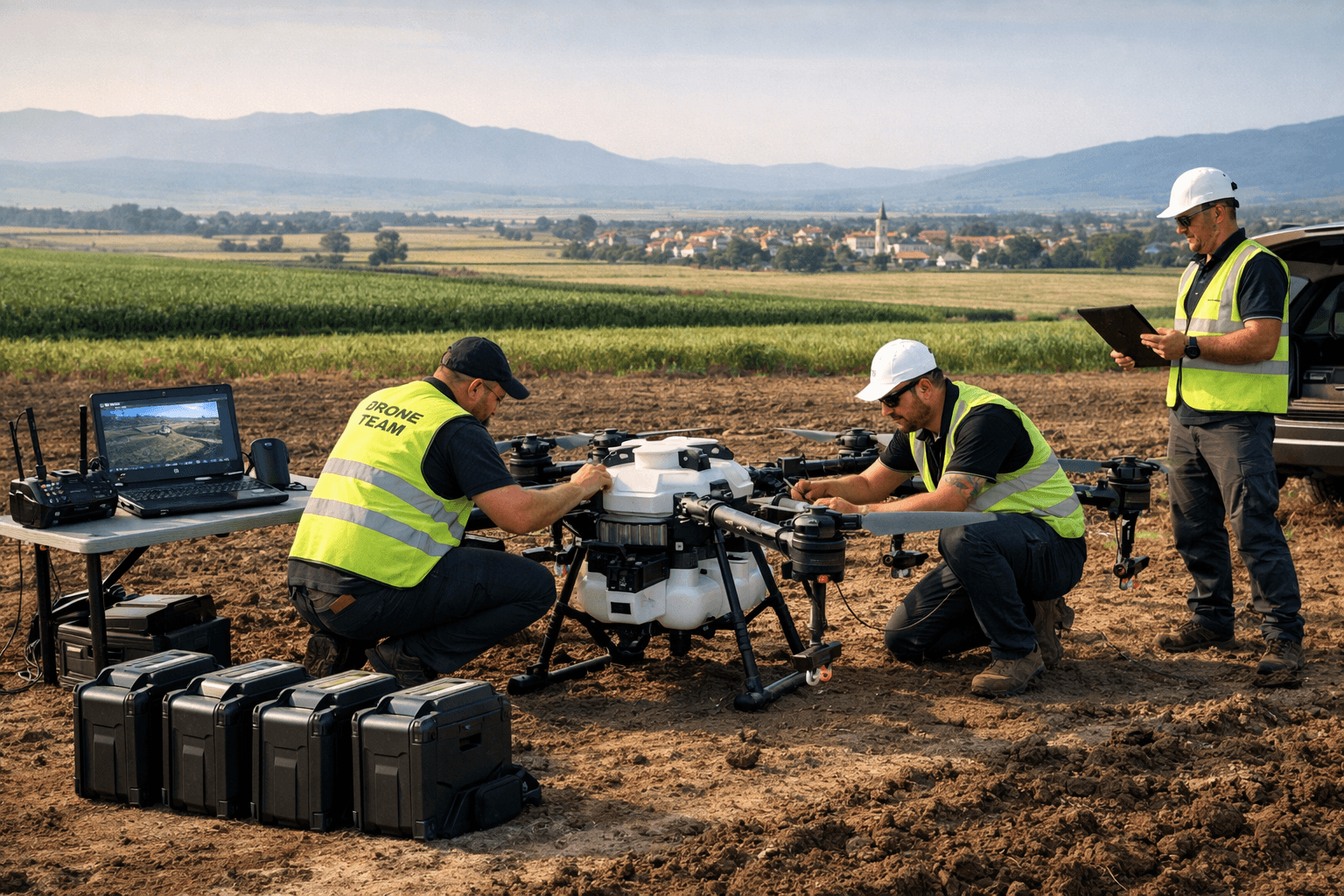
Our team arrives at the agreed location with all necessary equipment:
- DJI Agras T50 – the main agricultural drone
- Battery set – ensuring continuous operation
- Generator or charging unit – for charging batteries in the field
- Water tank and mixing unit – for preparing the solution
- Protective equipment – for safe work with preparations
Setup and Calibration
Before spraying begins, the operator:
- Checks meteorological conditions on-site
- Calibrates the RTK system for maximum navigation accuracy
- Sets spray parameters – height, speed, rate, droplet size
- Carries out a test flight to verify the system
- Prepares the working solution according to the manufacturer's instructions
The Spraying Itself
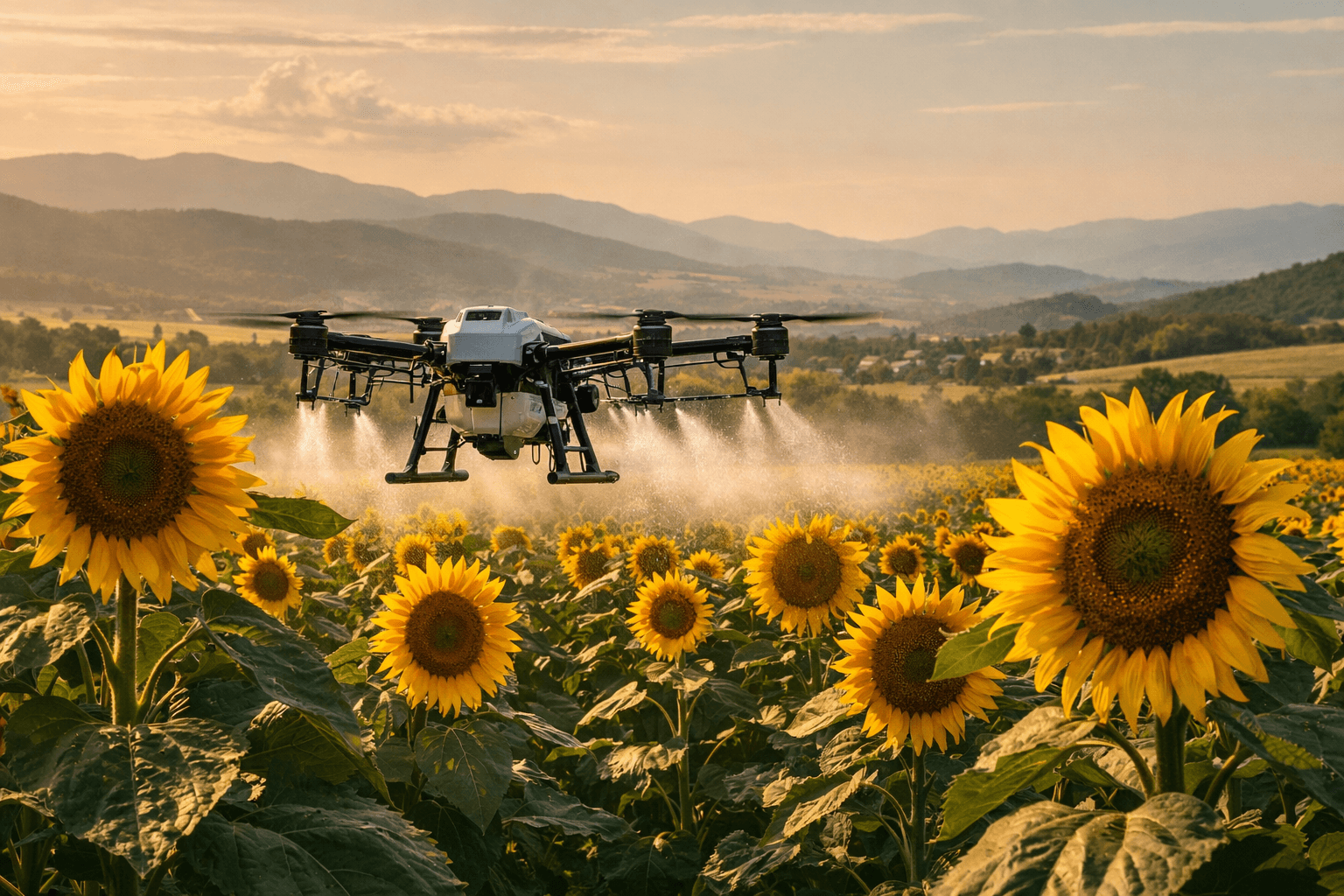
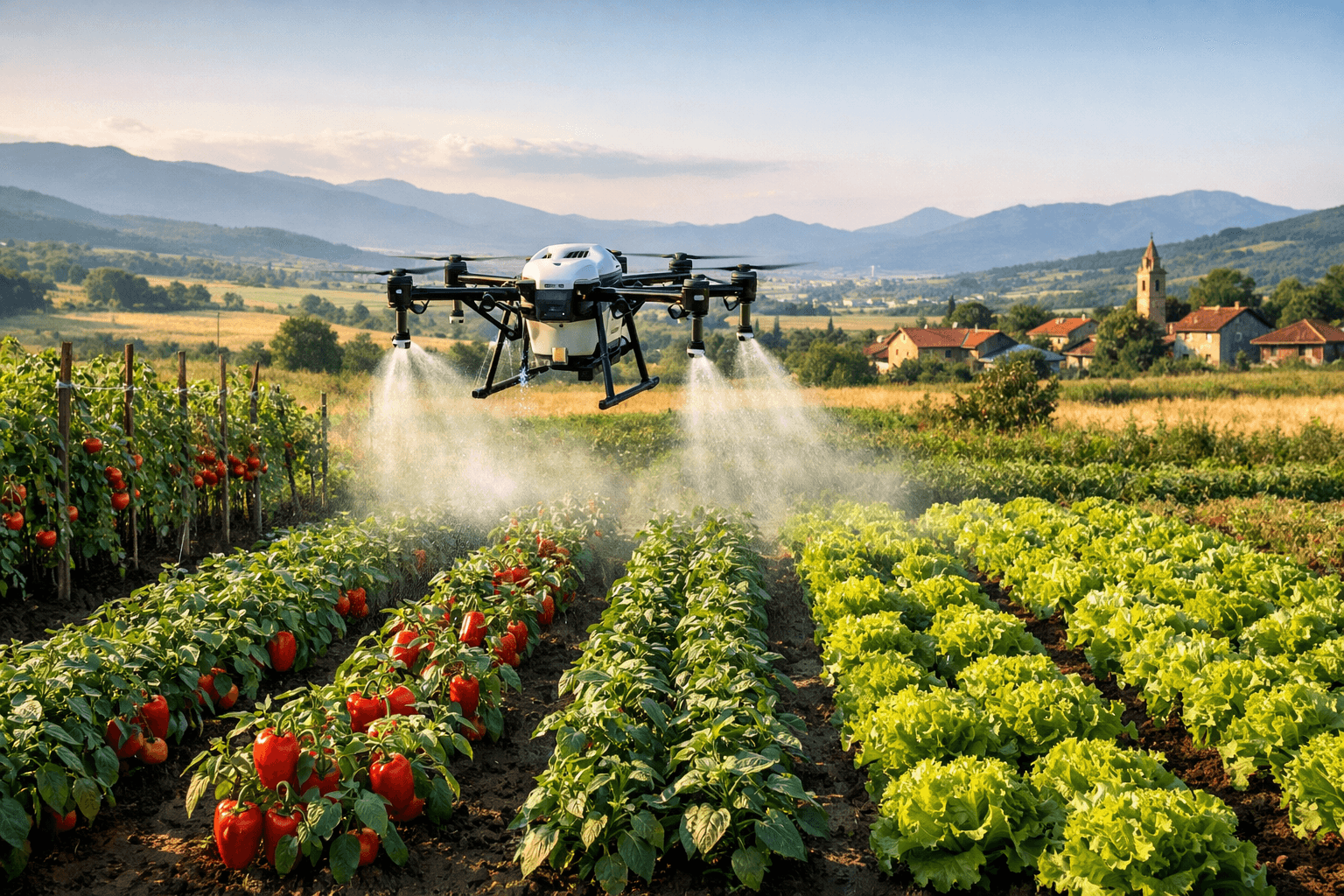
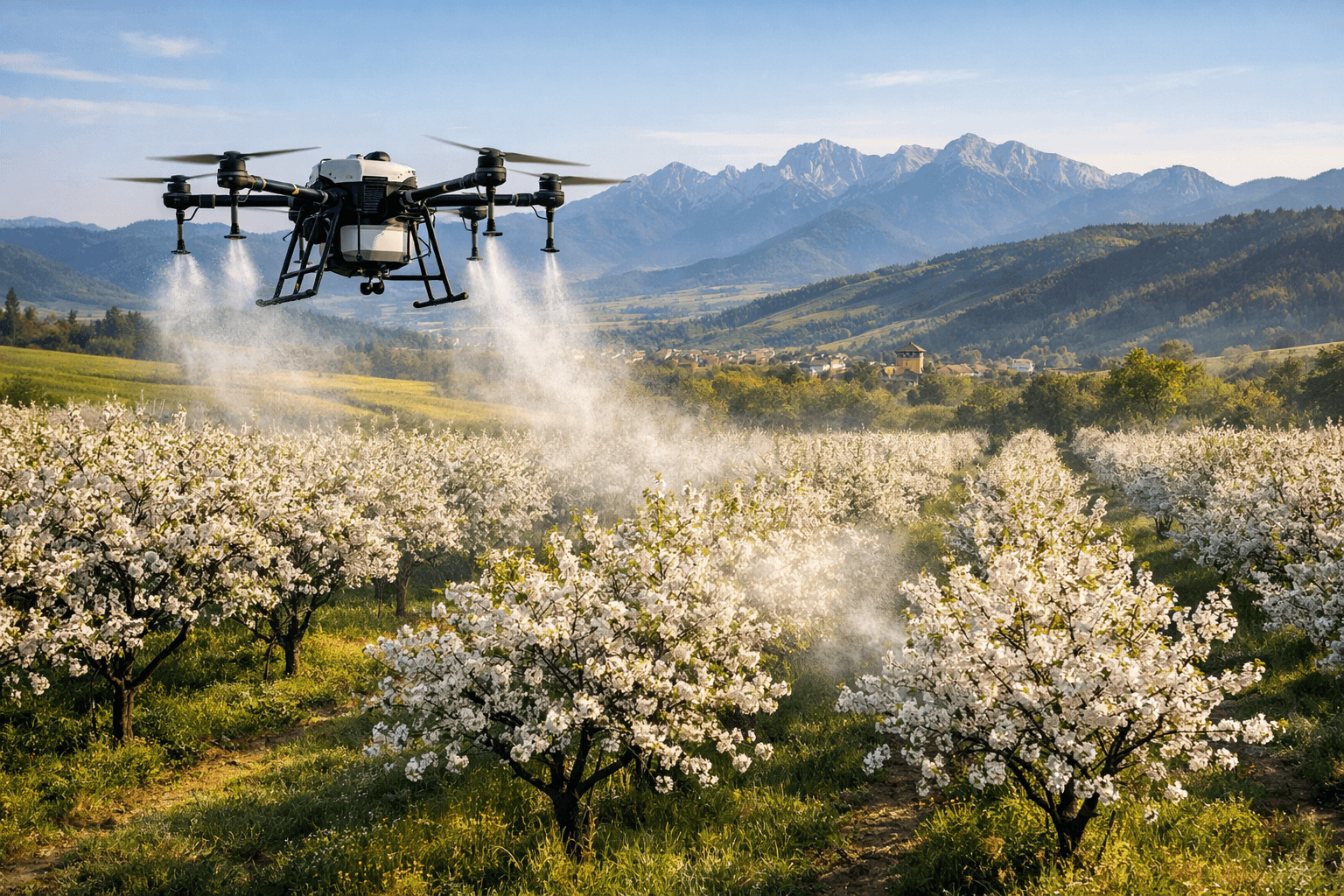
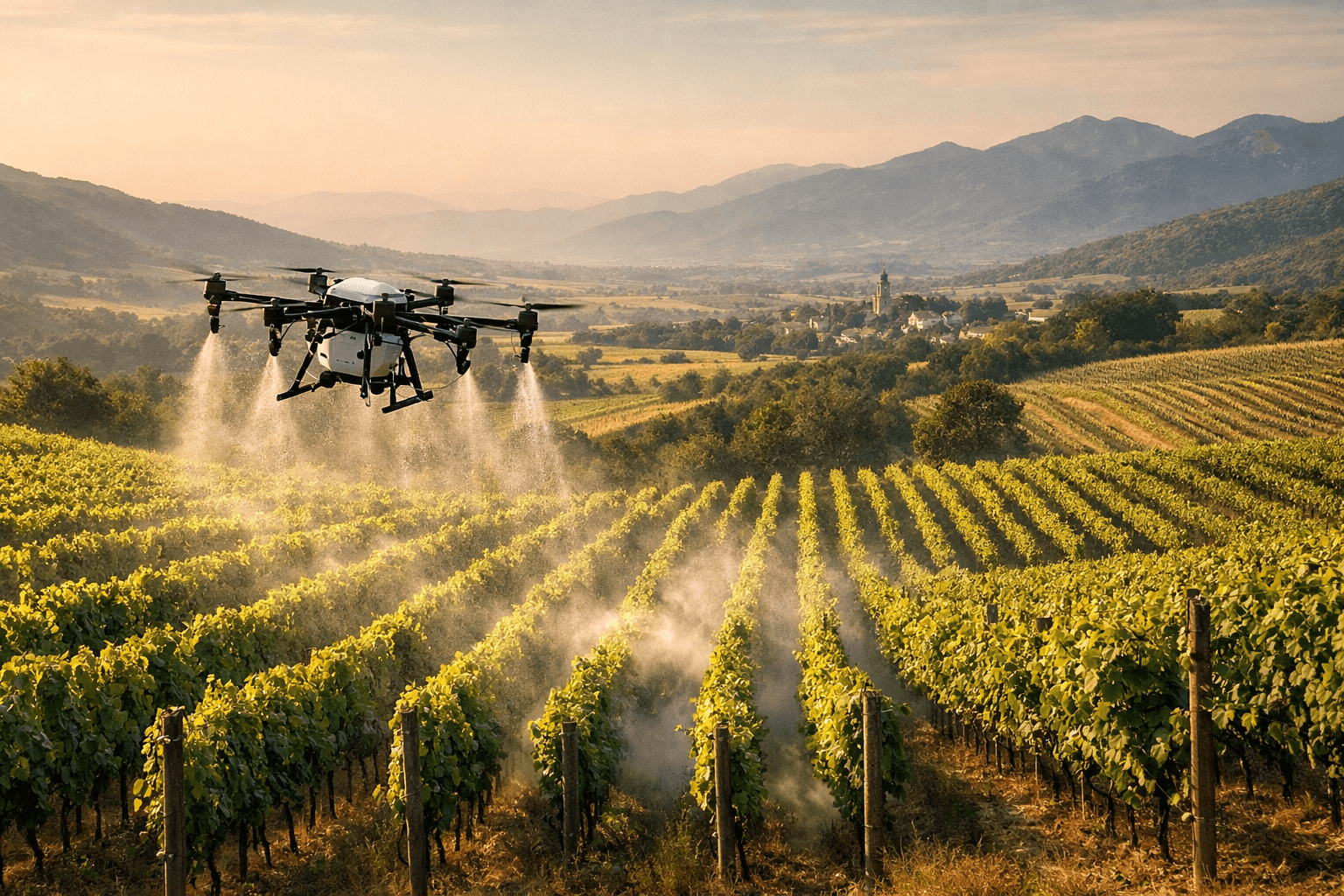
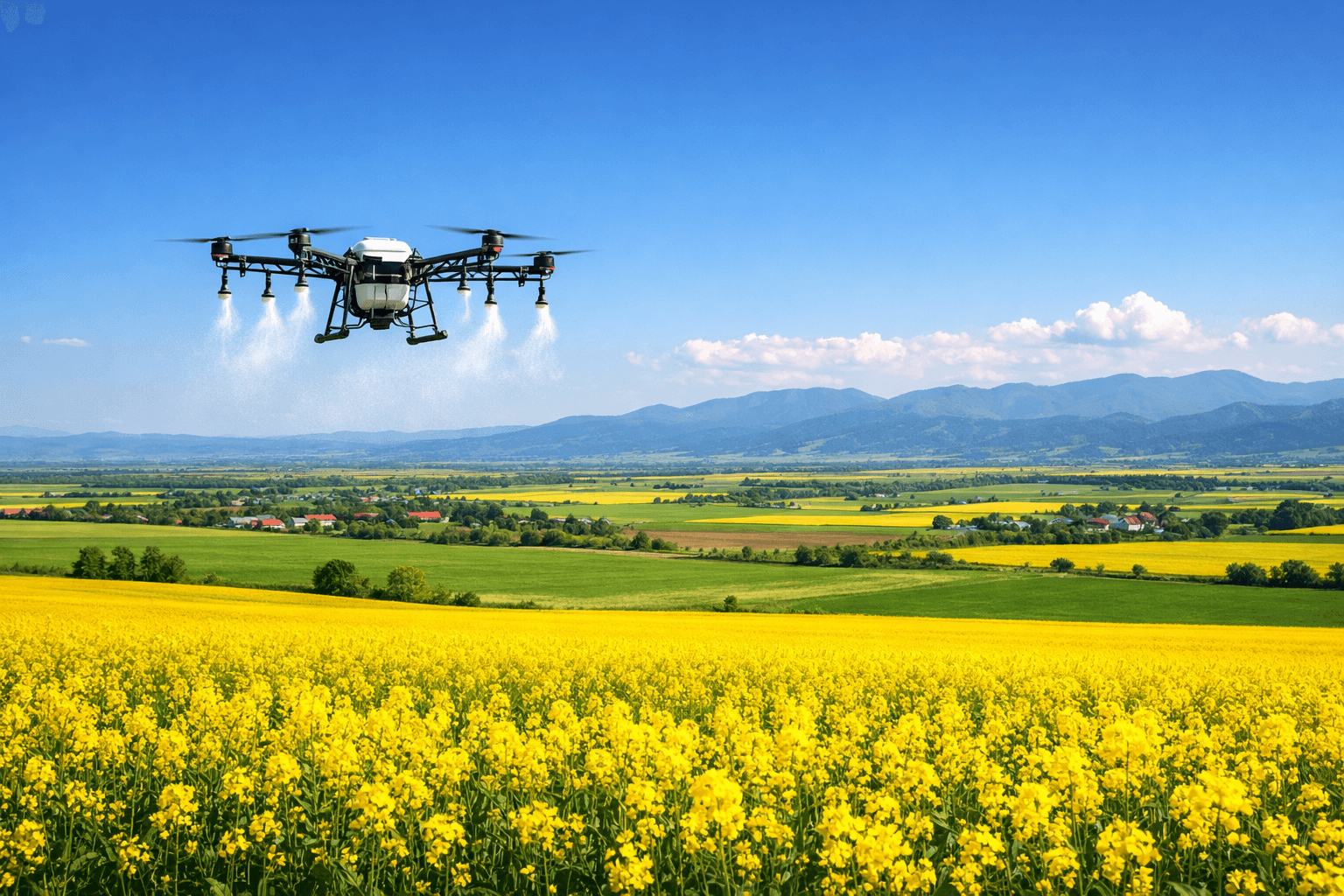
The drone takes off and follows the pre-set route. Here is what happens:
- The drone flies at a height of 2–3 metres above the crop
- It moves at a speed of 5–8 m/s depending on settings
- It covers a strip of 8–11 metres width at each pass
- It automatically stops spraying when turning and resumes when entering a new pass
- When the tank is empty, it returns for refilling and continues from the point where it stopped
You can observe the process from a safe distance. Many of our clients see an agricultural drone spraying for the first time and are impressed by the speed and precision.
Duration
Processing time depends on the area:
- 50 decares – approximately 20–30 minutes of actual spraying
- 200 decares – approximately 1–1.5 hours
- 500 decares – approximately 3–4 hours
- 1,000 decares – a full day's treatment
These times include refilling. Total time in the field may be slightly longer due to setup and solution preparation.
Step 6: After Treatment
Report on Work Performed
After treatment is complete, you receive a detailed report that includes:
- Map of the treated area – exact outline of the sprayed zone
- Total area in decares
- Amount used of preparation and solution
- Treatment time – start and finish
- Parameters – height, speed, application rate
- Meteorological conditions during treatment
This report is useful for your documentation and can be used when proof of treatment performed is required (for example for subsidies or insurance purposes).
What to Expect After Treatment
- Herbicides – the effect is visible after 5–14 days depending on the preparation
- Fungicides – the preventive effect is immediate, the curative effect – after 3–7 days
- Insecticides – the effect is rapid – usually within 24–48 hours
- Foliar fertilisers – improvement in colour and vitality is noticeable after 5–10 days
Follow-Up Communication
Our team remains available for questions after treatment. If you notice anything unusual or have additional needs, simply contact us.
Frequently Asked Questions
Do I need to be present during spraying?
It is not mandatory, but it is recommended, especially during the first treatment. That way you can see how the process works and ask questions.
What happens in bad weather?
If meteorological conditions are not suitable, we reschedule for the next appropriate day. Our priority is the effectiveness of the treatment, not merely performing it.
Can I enter the field after spraying?
Observe the pre-harvest interval specified by the preparation manufacturer. It is usually between 24 hours and 7 days depending on the product.
What is the minimum area?
We work with areas from 20 decares upwards. For smaller areas, please contact us for an individual assessment.
What if the drone breaks down during operation?
Our team carries backup equipment and can continue the work. We also have full insurance, so you carry no risk.
Why Choose AirAgro for Agricultural Drone Spraying
Choosing the right provider for agricultural drone spraying is an important decision. Here is why AirAgro is the right choice:
- Experience – dozens of treated farms and thousands of decares in Plovdiv, Stara Zagora, Pazardzhik, Haskovo, Dobrudzha and Thrace
- Professionalism – certified pilots and modern equipment
- Reliability – we meet agreed timelines
- Transparency – clear quote, no hidden costs, full report
- Consultation – we don't just spray, we help with the optimal solution with a free farm inspection
- Modern equipment – DJI Agras T50 with RTK navigation
For full information on our services, visit our drone spraying services page.
Start Today – Request a Free Consultation
The process of ordering agricultural drone spraying is easier than you might think. We take care of the technical side – you simply need to tell us what you need.
Three simple steps to modern crop protection:
- Request a free consultation – share basic information about your field and needs, receive a free farm inspection
- Receive a personalised treatment plan – with specific preparation and timing recommendations, no obligation, within 24 hours
- Schedule treatment or a drone demonstration – choose a convenient date and we come to you
Your crops deserve the best. Hundreds of farmers from Plovdiv, Stara Zagora, Pazardzhik, Haskovo, Dobrudzha and Thrace already trust AirAgro for their crop protection. Contact us at airagro.bg and take the first step towards more effective and more successful farming.
Request a free consultation from AirAgro today!