Drone vs Tractor – Cost Comparison for Spraying
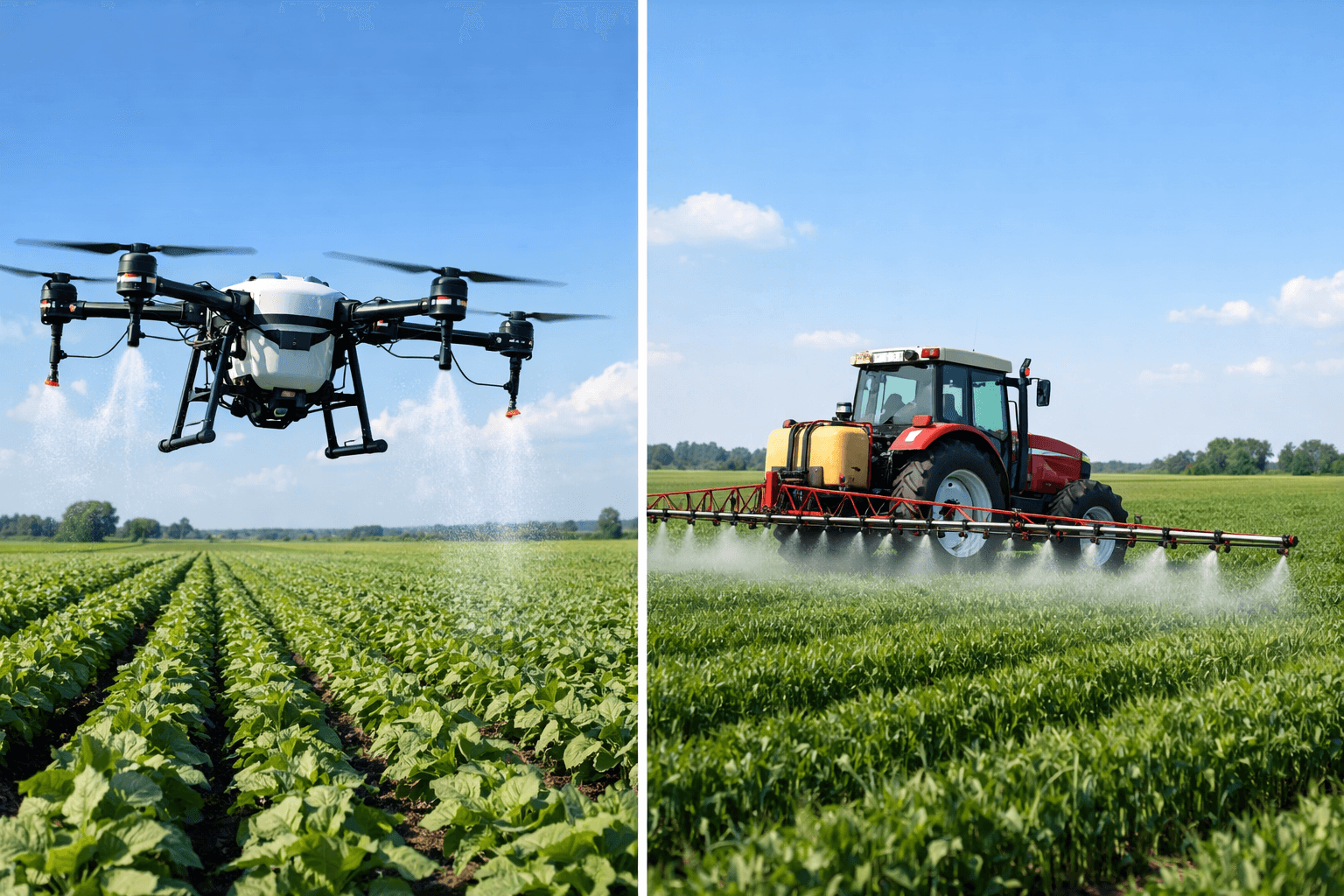
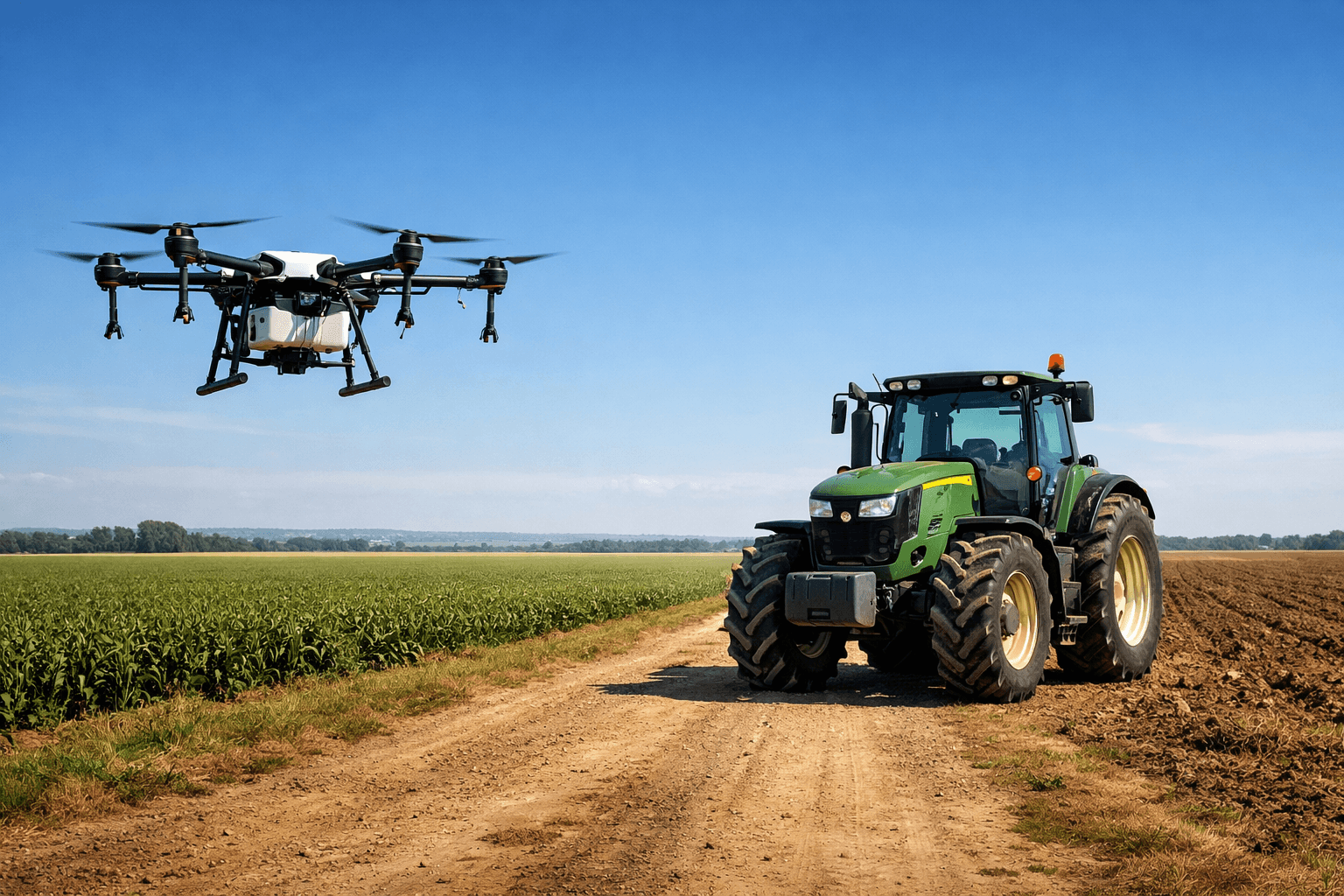
The question drone vs tractor is increasingly relevant for Bulgarian farmers seeking ways to optimise their operations. The traditional tractor-and-boom method has been the established practice for decades, but the emergence of agricultural drones such as the DJI Agras T50 offers a serious alternative. In this article we perform a detailed comparison of spraying costs – from fuel and preparations, through trampling losses, to the final profitability for farms of different sizes.
Why the Comparison Matters
Every farmer knows that spraying is one of the most expensive operations in arable farming. Crop protection costs can reach 15–25% of total production costs. Therefore, choosing the right spraying method can save thousands of BGN per year.
When comparing drone vs tractor, we must account not only for direct costs but also hidden ones – losses from trampling, overuse of preparations, downtime due to poor weather and equipment depreciation.
Direct Costs: Fuel and Energy
Tractor
A standard tractor with a spray boom (12–24 m) consumes an average of 1.2–1.8 litres of diesel per decare when spraying. At a price of approximately 2.80 BGN/L, this means:
- Fuel cost: 3.36–5.04 BGN/dka
To this are added the costs of transport to the field (especially for remote plots) and operation of the pumping system.
Drone (DJI Agras T50)
The DJI Agras T50 operates on rechargeable batteries. One charge allows treatment of approximately 20–25 dka. The electricity cost is minimal – approximately 0.15–0.25 BGN/dka.
- Energy cost: 0.15–0.25 BGN/dka
The difference in energy costs is over 15 times in favour of the drone.
Preparation Use – the Key Advantage
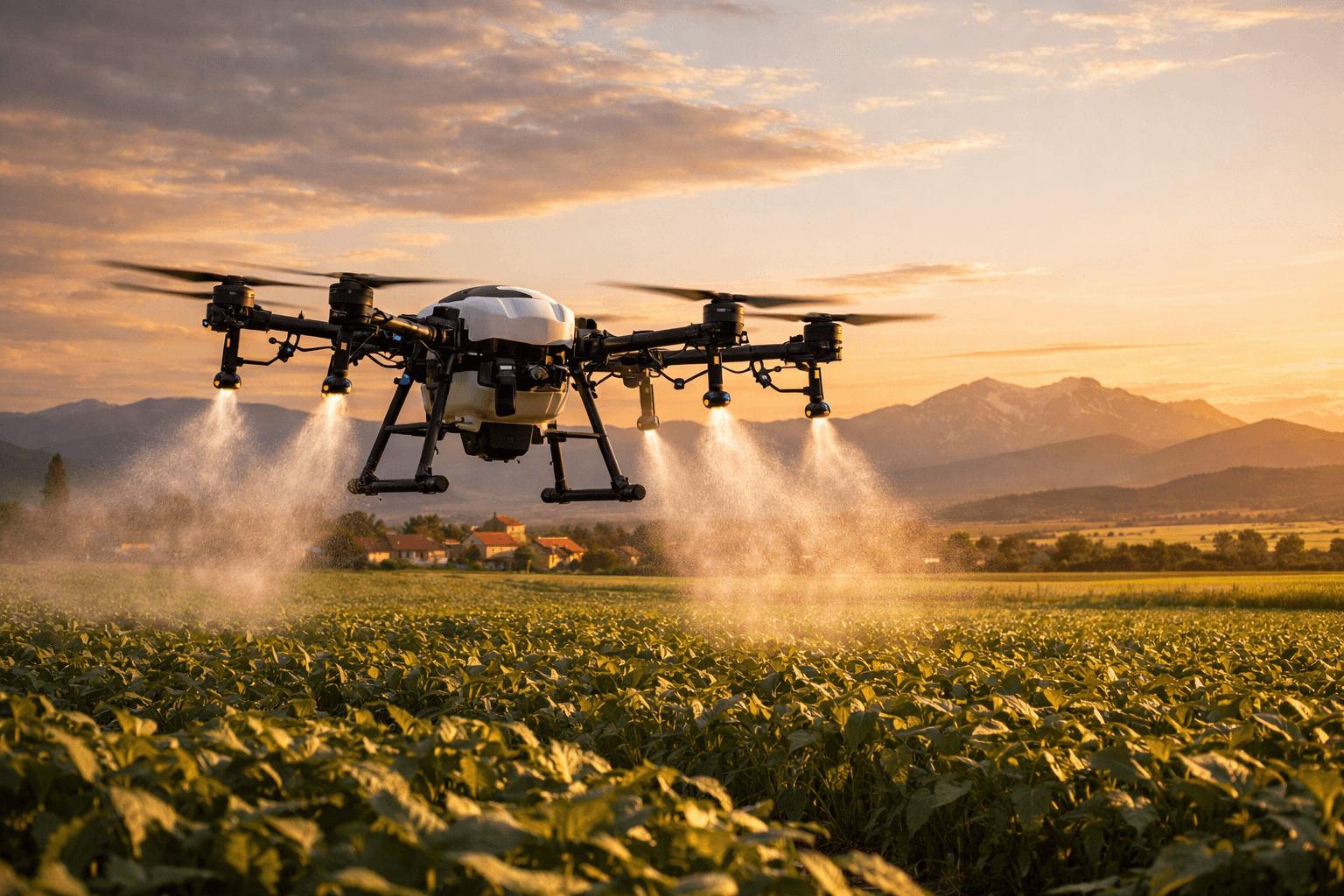
Here the drone demonstrates one of its most significant advantages over the tractor. Thanks to the centrifugal nozzles and precise flow control, agricultural drones achieve considerably more effective coverage with less working solution.
Tractor
- Working solution: 20–40 litres per decare
- Greater water use means more preparation for dilution
- Uneven application at turns and strip overlaps
Drone
- Working solution: 1–2 litres per decare (ULV technology)
- Precision centrifugal nozzles with controlled droplet size
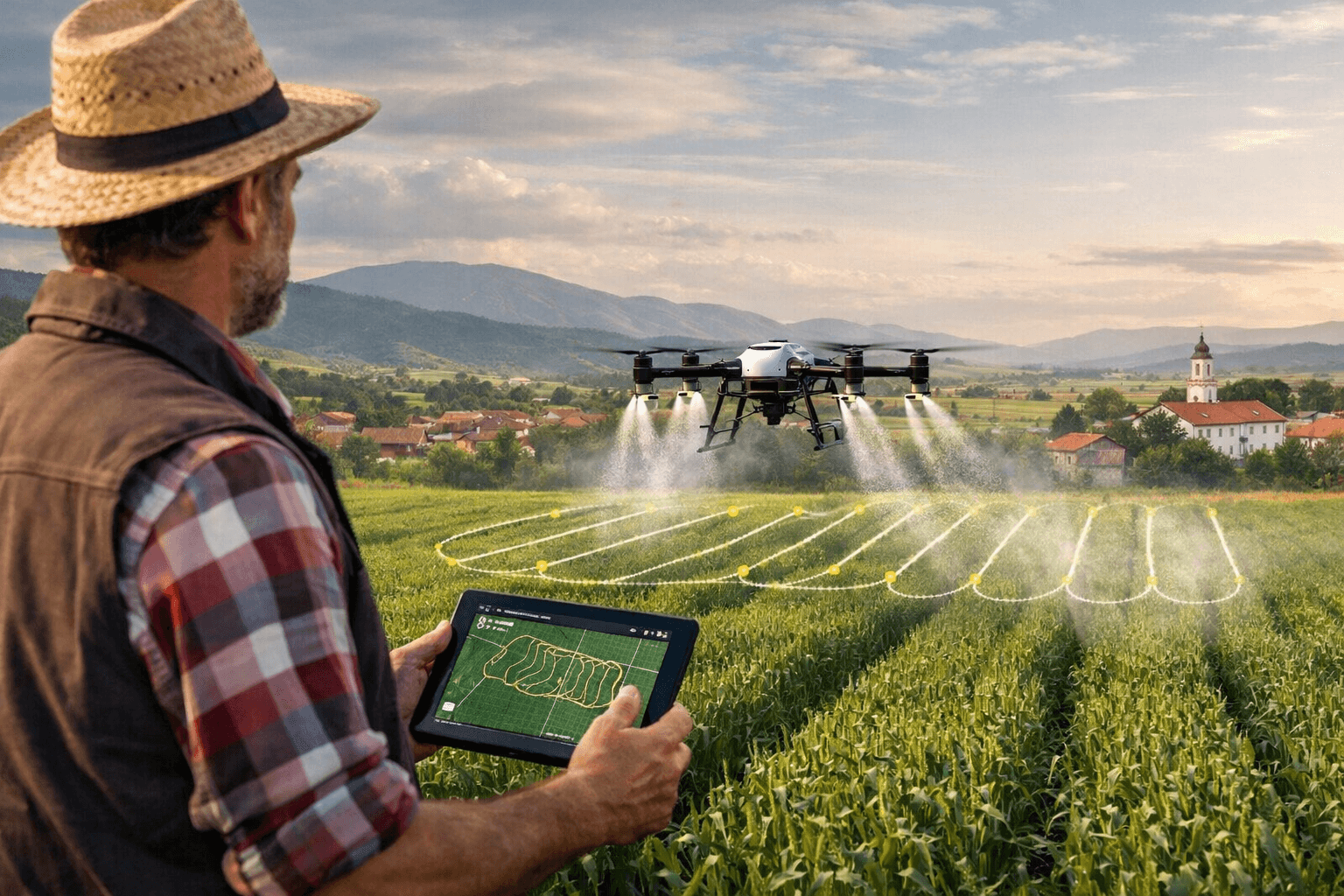
- Uniform coverage thanks to RTK GPS navigation
Preparation savings with drone: 20–30%. At an average preparation cost of 8–15 BGN/dka, this saving means 1.60–4.50 BGN/dka saved from more effective application alone.
Losses from Crop Trampling
This is the hidden cost that most farmers underestimate. When a tractor with a sprayer passes through the field, the wheels trample strips of the crop. Research shows that:
- The tractor tramples 3–5% of the area with every pass
- With 3–4 sprayings per season, the cumulative loss is significant
- Trampled plants yield 30–50% lower in the affected zones
Calculating the Losses
For wheat with a yield of 500 kg/dka and a price of 0.40 BGN/kg:
- Yield loss from trampling: 6–10 BGN/dka per season
With a drone, these losses are zero – the drone flies at 2–3 metres above the crop and does not touch a single plant. This is especially important for wheat spraying, rapeseed and other crops sensitive to mechanical damage.
Labour and Manpower
Tractor
- A qualified tractor operator is required
- Average salary: 80–120 BGN/day
- Productivity: 200–400 dka/day (depending on boom width)
- Labour cost: 0.20–0.60 BGN/dka
Drone
- A trained operator is required
- One operator manages the DJI Agras T50 with productivity of up to 530 dka/day
- When hiring a service – labour is included in the price
- Labour cost with a service: included in 4–8 BGN/dka
Depreciation and Maintenance
Tractor with Sprayer
| Component | Value | | ----------------------- | -------------------- | | Tractor (used) | 40,000–80,000 BGN | | Mounted sprayer (18 m) | 8,000–15,000 BGN | | Annual maintenance | 3,000–6,000 BGN | | Depreciation (10 years) | 4,800–9,500 BGN/year |
Drone (DJI Agras T50)
| Component | Value | | ---------------------- | ---------------------- | | DJI Agras T50 drone | ~120,000 BGN | | Batteries and chargers | 15,000–25,000 BGN | | Annual maintenance | 5,000–10,000 BGN | | Depreciation (5 years) | 27,000–35,000 BGN/year |
At first glance the drone appears more expensive as an investment. But here comes the key question – what is the farm's scale and whether to hire a service rather than buy a drone.
ROI Analysis by Farm Size
Farm of 500 Decares
| Indicator | Tractor | Drone (service) | | --------------------------- | --------------- | --------------- | | Fuel/Energy | 2,100 BGN | 100 BGN | | Preparations (saving) | – | -1,500 BGN | | Trampling losses | 4,000 BGN | 0 BGN | | Labour | 200 BGN | included | | Service price (4 sprayings) | – | 12,000 BGN | | Depreciation | 4,800 BGN | – | | TOTAL per season | ~11,100 BGN | ~10,600 BGN |
For 500 dka, the drone service is comparable to the tractor, but with the advantage of zero trampling and better spraying quality.
Farm of 1,000 Decares
| Indicator | Tractor | Drone (service) | | --------------------------- | --------------- | --------------- | | Fuel/Energy | 4,200 BGN | 200 BGN | | Preparations (saving) | – | -3,000 BGN | | Trampling losses | 8,000 BGN | 0 BGN | | Labour | 400 BGN | included | | Service price (4 sprayings) | – | 24,000 BGN | | Depreciation | 4,800 BGN | – | | TOTAL per season | ~17,400 BGN | ~21,200 BGN |
For 1,000 dka the tractor comes out cheaper in absolute amount, but when we include qualitative differences – better coverage, fewer chemicals in the soil and higher yield due to no trampling – the drone is a competitive option.
Farm of 5,000 Decares
| Indicator | Tractor | Drone (own) | | --------------------- | --------------- | --------------- | | Fuel/Energy | 21,000 BGN | 1,000 BGN | | Preparations (saving) | – | -12,000 BGN | | Trampling losses | 40,000 BGN | 0 BGN | | Labour | 2,000 BGN | 8,000 BGN | | Depreciation | 9,500 BGN | 35,000 BGN | | Maintenance | 6,000 BGN | 10,000 BGN | | TOTAL per season | ~78,500 BGN | ~42,000 BGN |
For 5,000 dka the drone saves over 35,000 BGN per year – primarily from prevented trampling losses and preparation savings.
Factors Beyond Numbers
Speed and Flexibility
The DJI Agras T50 can be deployed in minutes and work on irregularly shaped fields, slopes or wet terrains where the tractor cannot enter. This is a critical advantage for emergency treatments – for example, upon sudden appearance of pests.
Vortex Technology – an Advantage the Tractor Cannot Offer
The DJI Agras T50 uses Vortex technology – the vortex effect from the rotors creates a powerful downwash airflow that directs preparation droplets deep into the leaf mass. This ensures uniform coverage of the lower leaves and the interior of tree canopies – something that tractor sprayers physically cannot achieve. For crops such as vineyards, orchards and tall maize, the Vortex effect provides up to 40% better coverage compared to ground spraying.
Environmental Effect
With 20–30% fewer preparations and zero soil compaction, the drone is considerably gentler on the environment. This is important with regard to the growing EU requirements for sustainable agriculture.
Access to Hard-to-Reach Terrain
For vineyards, orchards and hilly terrain, the tractor is severely limited. The drone can treat any terrain – from the plains of Dobrudzha to the hilly vineyards of Thrace.
When Is the Tractor the Better Choice?
Honesty requires us to say that the tractor still has its advantages:
- Very large flat areas (over 10,000 dka) with existing machinery
- Fertiliser incorporation – the tractor can combine spraying with mechanical cultivation
- Low initial investment with already available machinery
- When the farmer already has trained staff and machinery
When Does the Drone Win Categorically?
- Medium farms (500–5,000 dka), especially when hiring a service
- Fields with irregular shapes or difficult terrain
- Crops sensitive to trampling (rapeseed, wheat in later stages)
- When dosing precision and a minimal ecological footprint are important
- For emergency treatments when the time window is short
Frequently Asked Questions
Which is cheaper per decare – drone or tractor?
Direct costs for tractor spraying are 3–6 BGN/dka, and for drone spraying – 4–8 BGN/dka. But when you add the hidden costs – trampling losses (6–10 BGN/dka per season), 20–30% preparation overuse and depreciation – the drone often works out more cost-effective for farms up to 5,000 dka. See current drone spraying prices.
What is the environmental effect of drone spraying compared to tractor?
The drone is considerably more environmentally friendly: 20–30% fewer preparations, 5–10 times less water, zero soil compaction and operating on electricity instead of diesel. This is important in view of the increasing EU requirements for sustainable agriculture. Read more about the advantages of drones in agriculture.
Can drone and tractor spraying be combined?
Yes, many farms apply a combined approach: the tractor for pre-sowing herbicide treatment and liquid fertiliser application, and the drone – for fungicide, insecticide spraying and foliar fertilisation during vegetation (when trampling is critical). This is especially popular among farms in the Thracian Plain and Dobrudzha.
What farm size is appropriate for a drone?
A drone service is optimal for farms of 500 to 5,000 decares – you get the quality of precision spraying without an equipment investment. For over 5,000 dka, purchasing an own drone may be considered. Even for small plots (from 5 dka) the drone is applicable – especially for vineyards and orchards around Plovdiv and Pazardzhik.
Can the drone spray at night?
Yes, this is one of the great advantages of the DJI Agras T50. Night spraying is even more effective – wind is weaker, humidity higher and preparations are absorbed better. The drone is equipped with LED lighting, radar and full autonomous navigation. The tractor cannot work at night with the same effectiveness.
Conclusion
The comparison drone vs tractor does not give an unambiguous answer – it depends on the specific farm. But the trend is clear: with falling drone service prices and growing requirements for precision, drones are becoming an increasingly competitive option.
For most Bulgarian farmers with areas between 500 and 5,000 decares, hiring a drone service is the optimal balance between cost and quality. And when we account for hidden trampling losses, the drone often turns out to be the more cost-effective choice.
Want to know exactly how much you will save with drone spraying? Request a free consultation and farm inspection from the AirAgro team. We work with the DJI Agras T50 and serve farms in the areas of Plovdiv, Stara Zagora, Pazardzhik, Haskovo, Dobrudzha and the Thracian Plain.
Request now:
- 🌾 Free consultation – individual calculation for your farm
- 🚁 Drone demonstration – see the DJI Agras T50 in action on your field
- 📋 Treatment plan – personalised programme for the whole season
- 💰 Personal comparison – detailed drone vs tractor analysis for your areas and crops
📞 Call or write to us – we will prepare a personal comparison for your areas and crops. See our drone spraying services and current prices.