Organic Farming and Drones – the New Formula for Sustainable Crop Protection
Organic farming in Bulgaria is experiencing unprecedented growth. According to data from the Ministry of Agriculture, certified organic areas in the country have exceeded 160,000 hectares, and demand for organic products grows by double-digit percentages every year. The European "Farm to Fork" strategy sets an ambitious goal – 25% of agricultural land in the EU to be managed organically by 2030.
For Bulgarian organic farmers, however, one critical question remains: how do you protect crops effectively when conventional pesticides are prohibited? The answer increasingly comes from the air – organic farming and drones is the combination that enables precision application of biopesticides with minimal consumption and maximum effect.
The Rise of Organic Farming in Bulgaria
Market Demand and European Support
The market for organic products in Europe exceeds 50 billion euros per year. Bulgarian producers benefit from several support mechanisms:
- Eco-schemes under CAP 2023–2027 – direct payments for organic farming that compensate for lower yields
- Measure 11 from the RDPE – support for transitioning to and maintaining organic production
- EU Green Deal – a political framework prioritising sustainable agriculture
- Growing domestic market – more and more Bulgarian consumers choose organic products in major chains such as Lidl, Kaufland and specialised organic shops
In regions such as Plovdiv, Stara Zagora and Pazardzhik, organic farms are increasing, especially for vegetables, vineyards and orchards. Dobrudzha and the Thracian Plain attract certified organic cereal producers.
What the Regulation Says
Organic farming in the EU is regulated by Regulation (EU) 2018/848, which defines which plant protection products are permitted. In Bulgaria, control is exercised by accredited certification bodies such as Balkan Biosert, LACON, Q-check and CERES. Every treatment must be documented – here drones offer a unique advantage, which we will discuss below.
The Challenges of Crop Protection in Organic Farming
Organic farmers face a significantly more complex task than conventional producers when it comes to crop protection.
Limited Range of Permitted Products
In organic farming only products of natural origin, approved under Annex I of Regulation (EC) 889/2008, are permitted. This means the farmer has no access to the wide arsenal of synthetic pesticides and must rely on less powerful but eco-friendly alternatives.
Treatment Timing Is Critical
Biopesticides in most cases have contact action – they must land directly on the pest or pathogen. They have no systemic action and do not move within the plant. This means that the window for effective treatment is narrow – if you are even one or two days late, effectiveness drops dramatically.
Labour-Intensive and High-Cost
Biopesticides generally require more frequent treatments at smaller doses. With ground spraying this means repeatedly bringing machinery into the field – more labour, more fuel and more soil compaction. For farms in the Haskovo and Stara Zagora area with scattered plots, transport and logistics costs add further weight.
Sensitivity of Biopesticides
Many biological products – especially those based on live micro-organisms – are sensitive to UV radiation, high temperature and improper mixing. Precise dosing and uniform application are critically important.
How Drones Solve These Problems
Organic farming and drones – this combination works because drone technology responds precisely to the specific needs of organic farms.
Precision Application at Low Volumes
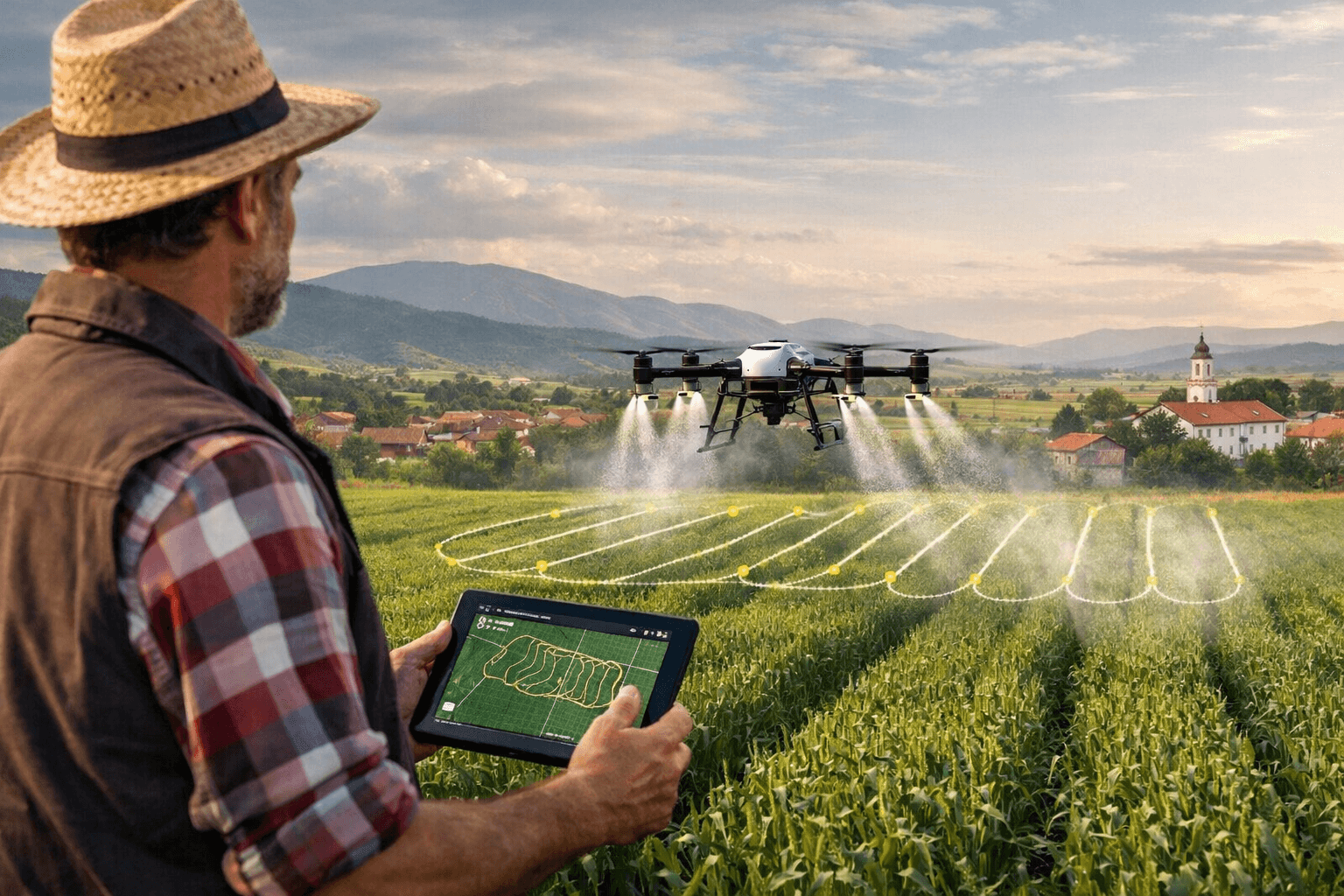
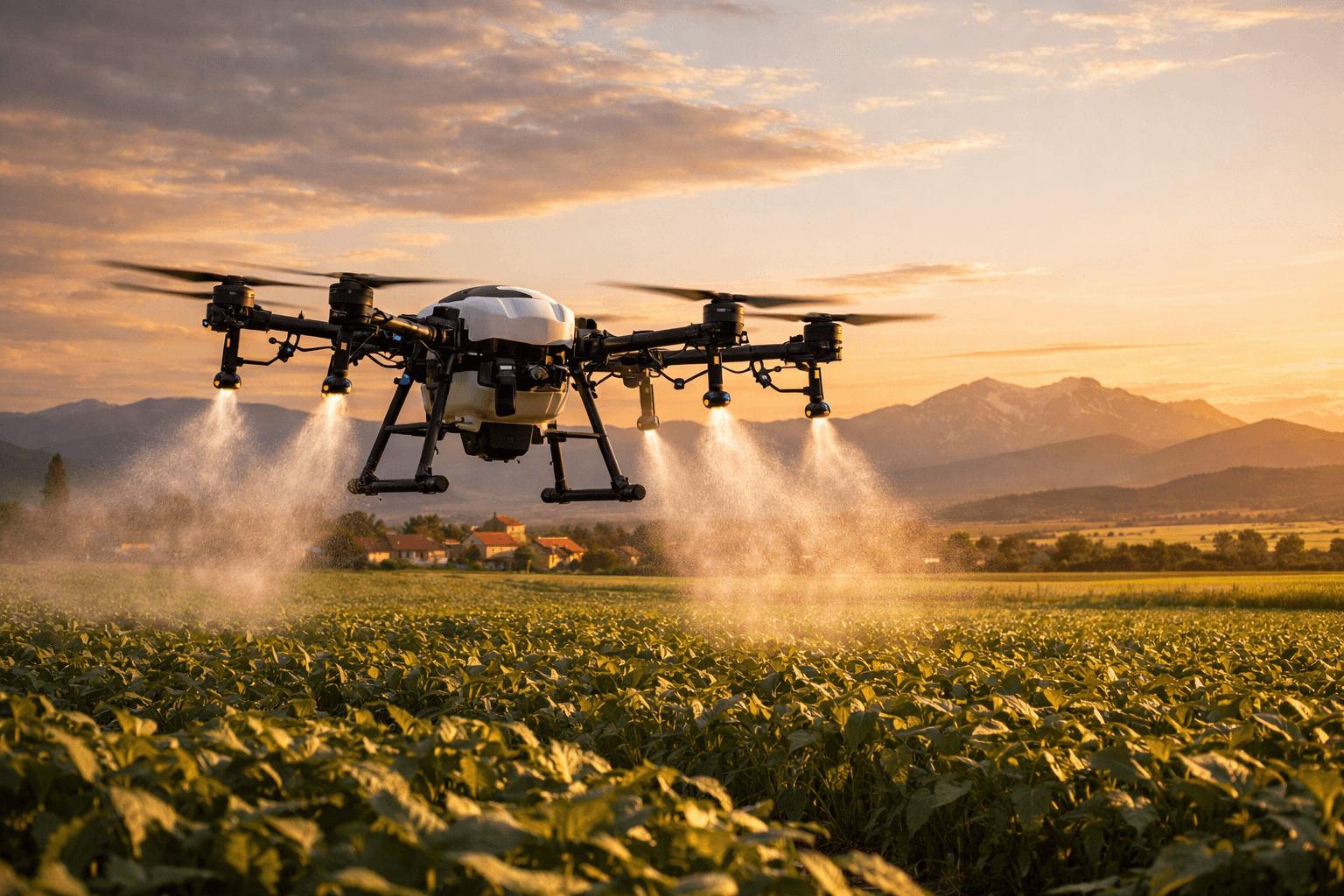
The DJI Agras T50 works at ultra-low volume (ULV) – from 1 to 3 litres per decare. This is ideal for biopesticides that need uniform coverage rather than soaking the plant. The centrifugal nozzles disperse fine droplets with controlled size (80–300 microns), providing optimal coverage of the leaf surface.
Zero Soil Compaction
Organic farmers pay special attention to soil health – it is the foundation of organic production. The drone does not touch the soil, does not compact it or damage its structure. This is a critical advantage when multiple treatments are required, typical of organic systems.
Speed and Narrow Treatment Window
The drone treats up to 20 decares per hour, enabling quick action when conditions are suitable. If the biopesticide must be applied early in the morning before UV radiation, or immediately after a pest appears, the drone can respond within hours, not days.
Reduced Preparation Consumption
Precision drone application means 30–50% less biopesticide consumption compared to ground spraying. With prices of biopesticides that are 2–3 times higher than conventional ones, this saving is significant for organic farm profitability.
Access to Any Terrain
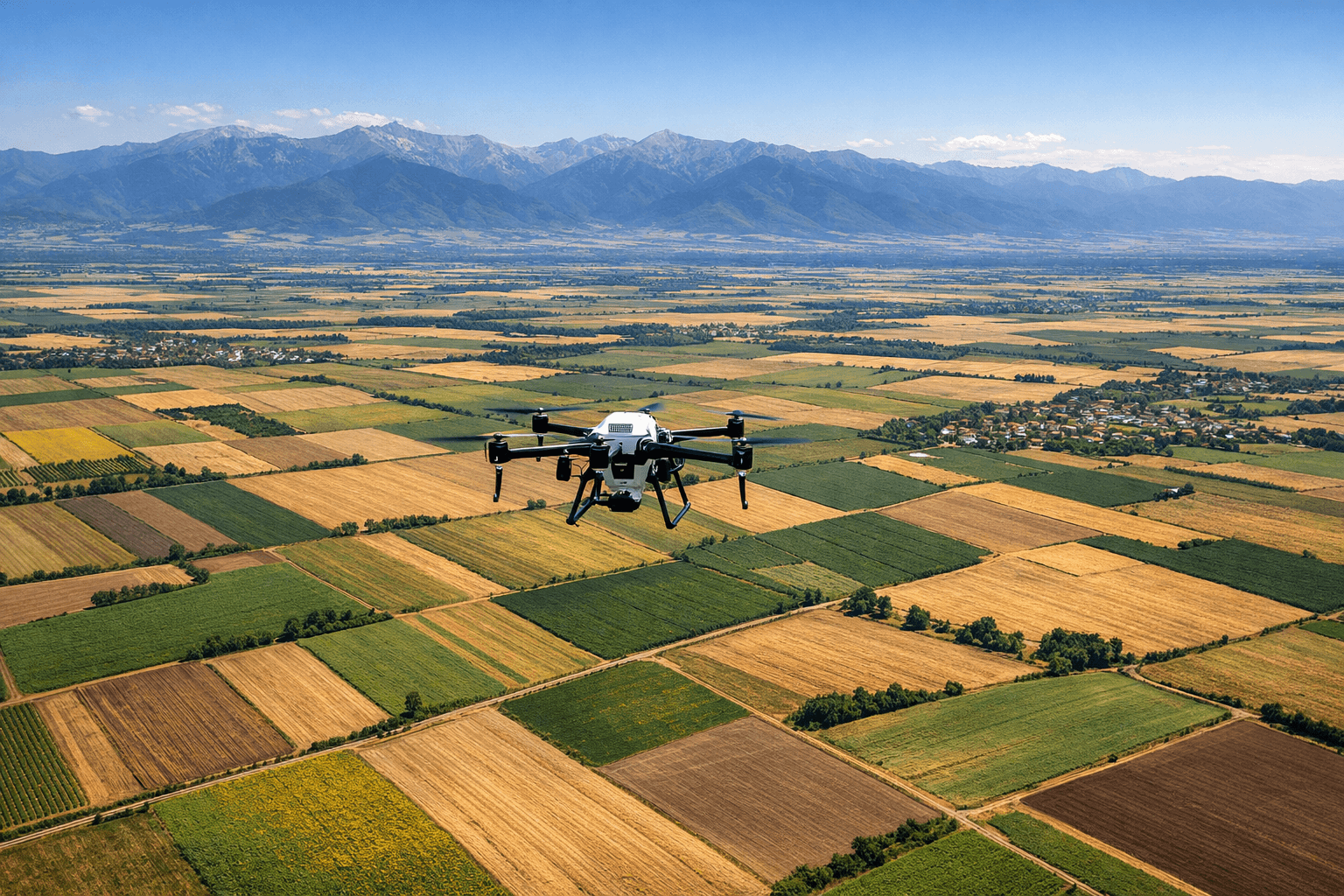
In organic vineyards, orchards and vegetable gardens – especially those on steep hills or with narrow row spacing – the drone is the only way to carry out effective treatment without damaging crops.
Approved Biopesticides Suitable for Drone Application
Not all biopesticides are equally suitable for ultra-low-volume spraying. Here are those that work excellently with the DJI Agras T50:
Bacillus thuringiensis (Bt)
"The gold standard" in biological caterpillar control. Products such as DiPel DF, Lepinox Plus and XenTari require uniform coverage of the leaf surface – precisely what the drone provides. Effective against grape berry moth, armyworms and leafrollers.
Spinosad
Produced by the soil bacterium Saccharopolyspora spinosa, spinosad is effective against thrips, Colorado potato beetle and fruit flies. Products such as SpinTor 240 SC are applied precisely in small volumes – a perfect scenario for drone treatment.
Copper Preparations
Bordeaux mixture, copper hydroxide (Kocide 2000) and copper oxychloride control downy mildew, peronospora and bacterial diseases. The drone ensures uniform coverage with minimal consumption – important given the restriction of a maximum of 4 kg Cu/ha per year under Regulation 2018/848.
Neem Oil (Azadirachtin)
Neem extract (NeemAzal-T/S) is effective against aphids, whitefly and mites. It works best with fine atomisation – exactly the conditions provided by the DJI Agras T50.
Biostimulants and Microbial Products
- Trichoderma – prophylaxis against soil-borne fungi
- Beauveria bassiana – entomopathogenic fungus against insects
- Humic and fulvic acids – plant strengthening
- Seaweed (Ascophyllum nodosum) – stress resistance
These products are living organisms or delicate substances – precision drone application preserves their viability better than high-pressure ground spraying.
DJI Agras T50 – Built for Precision Organic Farming
The DJI Agras T50 has characteristics ideal for organic farming:
- 40-litre tank – 15–40 decares per flight
- Centrifugal spray system – uniform fine droplets for optimal coverage
- RTK GNSS navigation – accuracy ±10 cm, without overlap and without gaps
- Obstacle avoidance system – safe operation in orchards and vineyards
- Adjustable droplet size – adapting to the type of biopesticide
For organic farms in the Plovdiv, Pazardzhik and Haskovo area, the drone pays for itself in the very first season through saved preparation and labour.
GPS Logs and Documentation for Organic Certification
One of the most underrated benefits of drone technology for organic farming is automatic documentation.
With every treatment the DJI Agras T50 generates a log file with date, time, GPS coordinates, amount of preparation, speed and spray flow rate. Certification bodies such as Balkan Biosert and LACON require full traceability – GPS logs provide irrefutable digital evidence that:
- Facilitate the annual inspection
- Reduce the risk of loss of certification
- Prove compliance with buffer zones around conventional plots
- Document the absence of preparation drift outside the treated area
This level of documentation is practically impossible with manual or ground spraying.
Economic Effect for Organic Farms
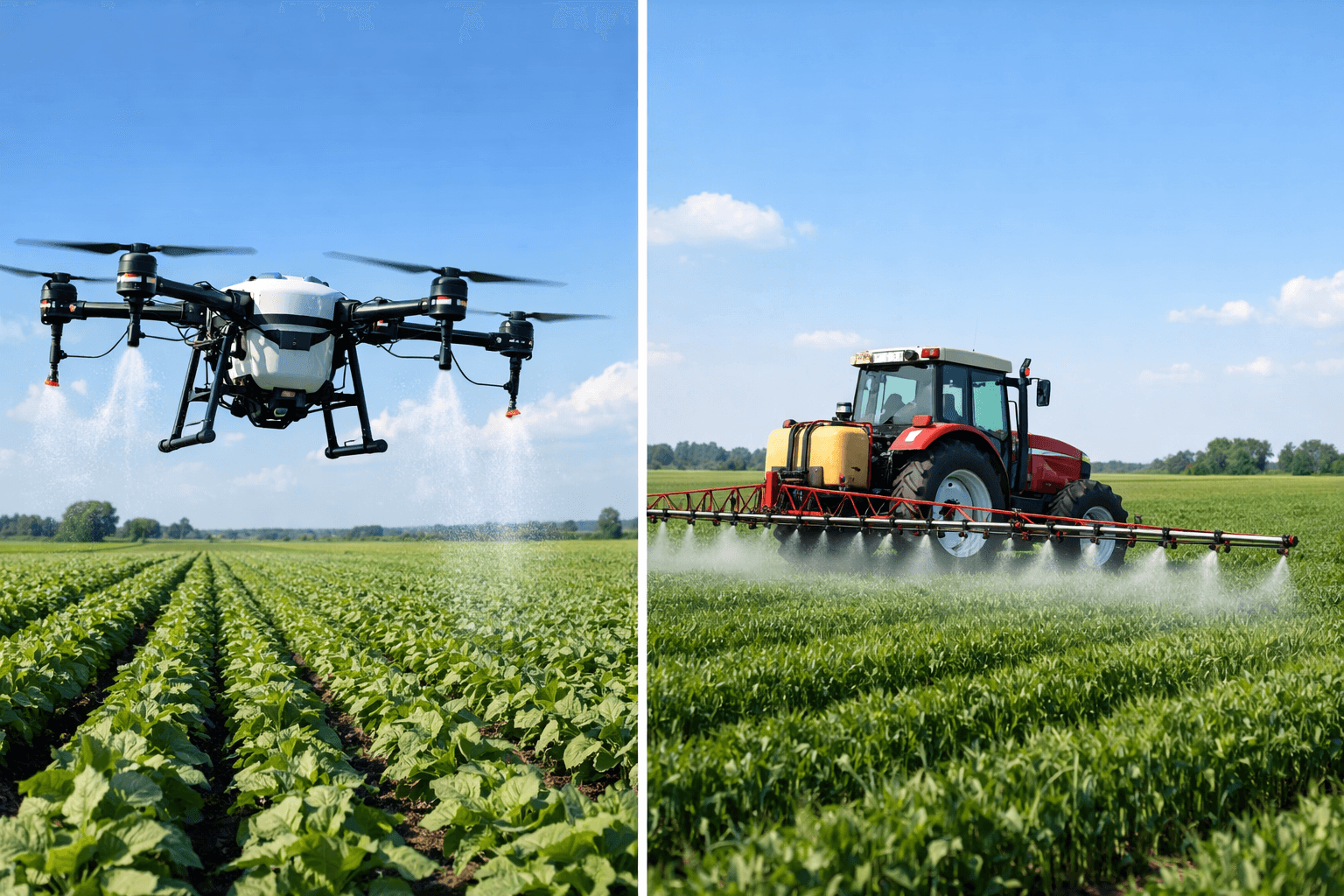
| Indicator | Ground spraying | Drone spraying | | ------------------------------- | --------------- | ------------------- | | Biopesticide consumption | 100% | 50–70% | | Treatment time (100 dka) | 4–6 hours | 1.5–2 hours | | Soil compaction | Significant | Zero | | Documentation for certification | Manual | Automatic (GPS log) | | Access to steep terrain | Limited | Full |
For a typical organic farm of 300–500 decares with 8–12 treatments per year, savings from drone spraying reach 3,000–8,000 BGN from reduced preparation and labour costs alone, not counting the benefits for soil health and produce quality.
Learn more about the terms and prices of our drone spraying services.
Frequently Asked Questions
Is spraying with a drone permitted in organic farming?
Yes. Drone spraying is an application method – the permission depends on the preparation, not the method of application. If the product is approved for organic farming under Regulation (EU) 2018/848, it can be applied by drone, hand sprayer or ground machinery.
Does the drone not damage biopesticides containing live organisms?
On the contrary – the drone is more gentle than ground sprayers. The centrifugal dispersal system of the DJI Agras T50 works at lower pressure compared to the hydraulic nozzles of ground machines, which preserves the viability of microbial preparations such as Bt, Trichoderma and Beauveria bassiana.
Can a drone be used for spraying small organic plots?
Yes. The drone is extremely effective for plots from 5 to 500 decares. For small organic farms in the Plovdiv, Stara Zagora and Dobrudzha area, the drone service is more cost-effective than purchasing specialised machinery.
How is it guaranteed that there is no contamination from conventional preparations?
Before every treatment for an organic farm, the drone and tank are thoroughly cleaned according to a standard decontamination procedure. We keep full documentation for each mission, ensuring traceability and peace of mind for the farmer.
How much does drone spraying for an organic farm cost?
The price depends on the area, crop type and terrain. Contact us for an individual quote – for many organic farms, drone treatment is more cost-effective than conventional spraying when the saved preparation is factored in.
Request Drone Spraying for Your Organic Farm
If you manage a certified or transitional organic farm in the area of Plovdiv, Stara Zagora, Pazardzhik, Haskovo, Dobrudzha or the Thracian Plain, the AirAgro team can help you with precision biopesticide spraying with the DJI Agras T50.
We offer:
- Spraying with preparations approved for organic farming
- Full GPS documentation for your certification body
- Rapid response upon pest appearance
- Consultation on appropriate biopesticides and dosages
📞 Call now: +359 884 242 406 or write to us to plan your first drone treatment.
AirAgro – precision crop protection for sustainable agriculture.