Technologies in Modern Agriculture – the Future of Farming
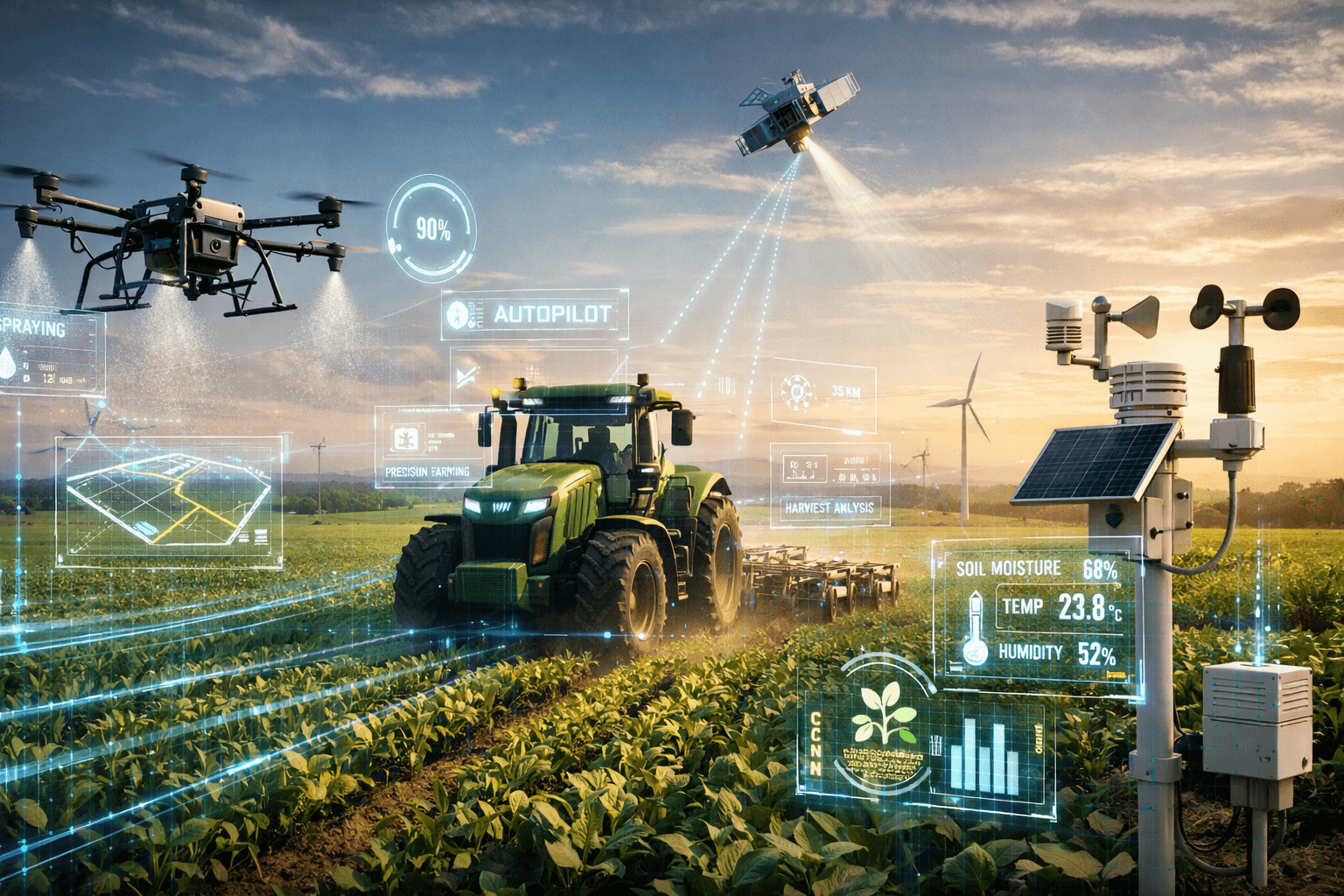
Agriculture is going through one of the most significant transformations in its history. While decades ago farmers relied solely on experience, intuition and manual labour, today technologies in modern agriculture offer tools that are fundamentally changing the way work is done in the field. From GPS navigation and agricultural drones to artificial intelligence and IoT sensors – innovations are no longer a distant future but a reality for more and more farms in Bulgaria and around the world.
In this article we will look at the main technologies that shape precision agriculture, and explain why drone solutions are the most accessible entry point for Bulgarian farmers.
GPS Navigation and Autopilot in Agriculture
How GPS Works in Farming
GPS technology has fundamentally changed the way agricultural areas are managed. Modern tractors and combines are equipped with GPS receivers that provide navigation with centimetre accuracy. This allows:
- Automatic machine guidance – the tractor follows a pre-set route without operator intervention
- Avoiding overlap – every part of the field is processed exactly once
- Operation in poor visibility – at night, in fog or dust, machines work with equal precision
- Documentation of treated areas – accurate reporting of every operation
RTK Correction for Maximum Accuracy
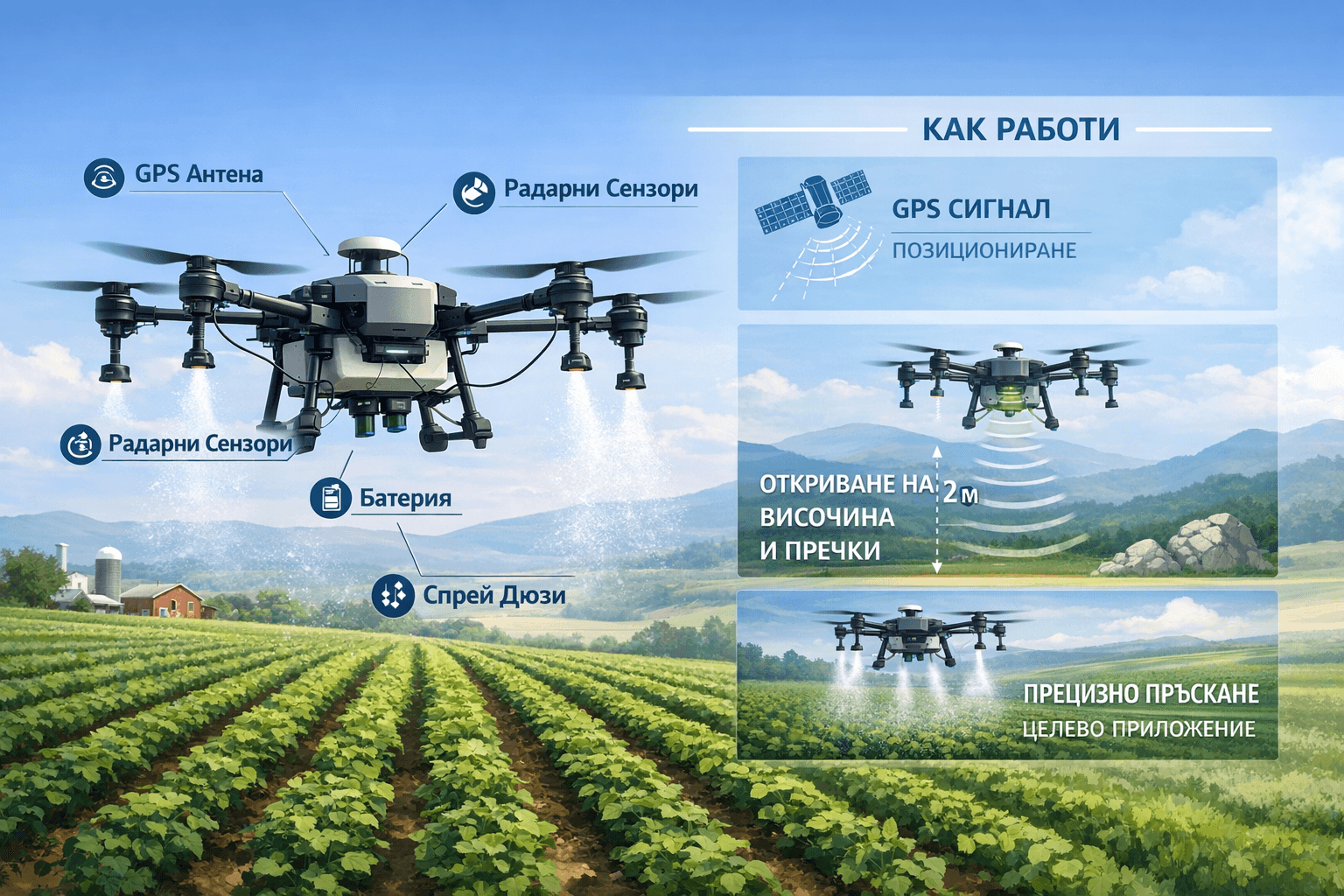
Standard GPS signals have an accuracy of around 2–3 metres, which is insufficient for precision operations. RTK (Real-Time Kinematic) correction improves accuracy to ±10 cm. This technology is also used in modern agricultural drones like the DJI Agras T50, providing precise spraying without gaps and overlap.
Agricultural Drones – a Revolution in Crop Protection
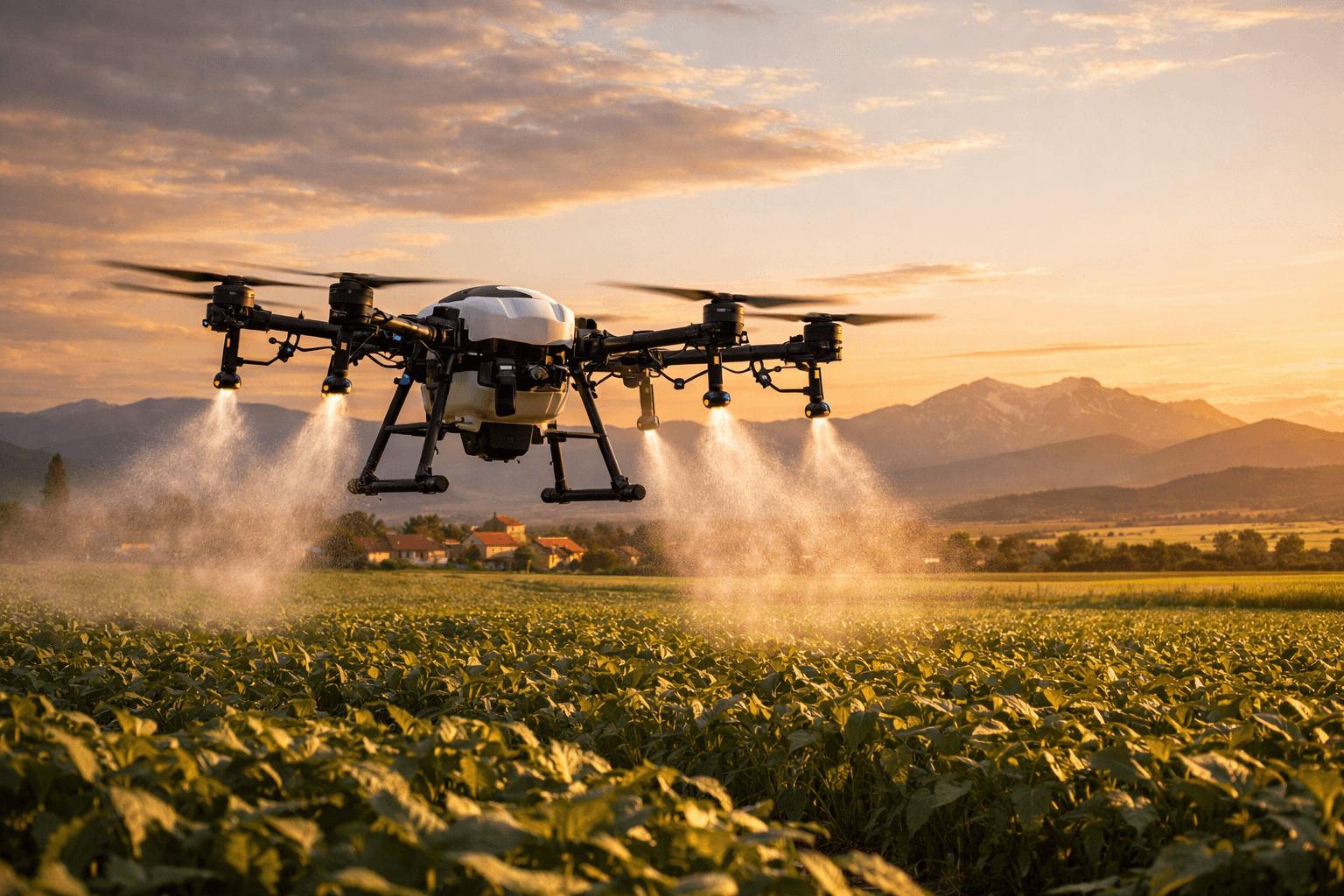
Agricultural drones are perhaps the most visible innovation in modern agriculture. They combine multiple technologies in one compact device and offer solutions that were previously unthinkable. Learn more about how agricultural drones work and what tasks they perform.
Main Applications of Drones
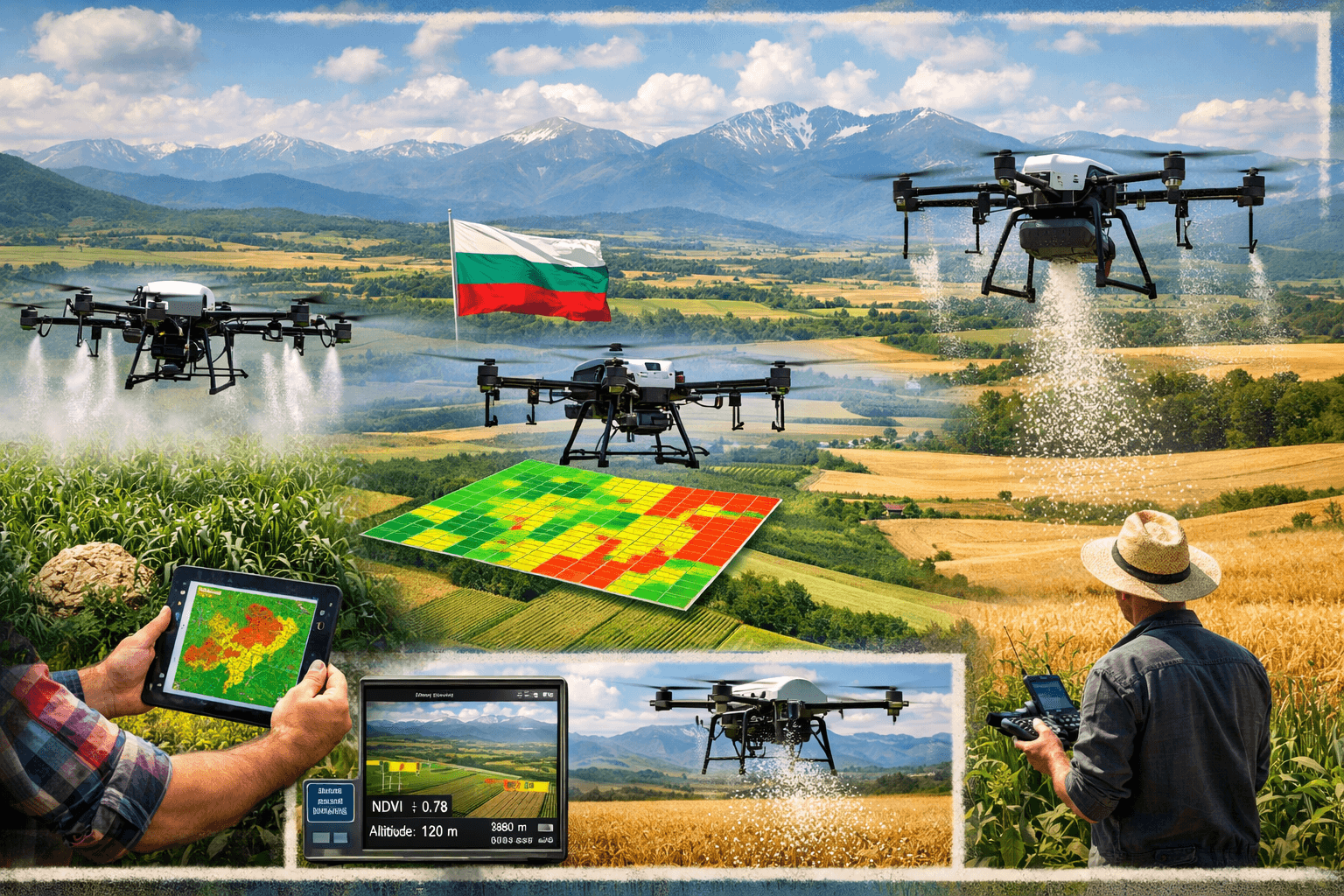
Agri drones are used for:
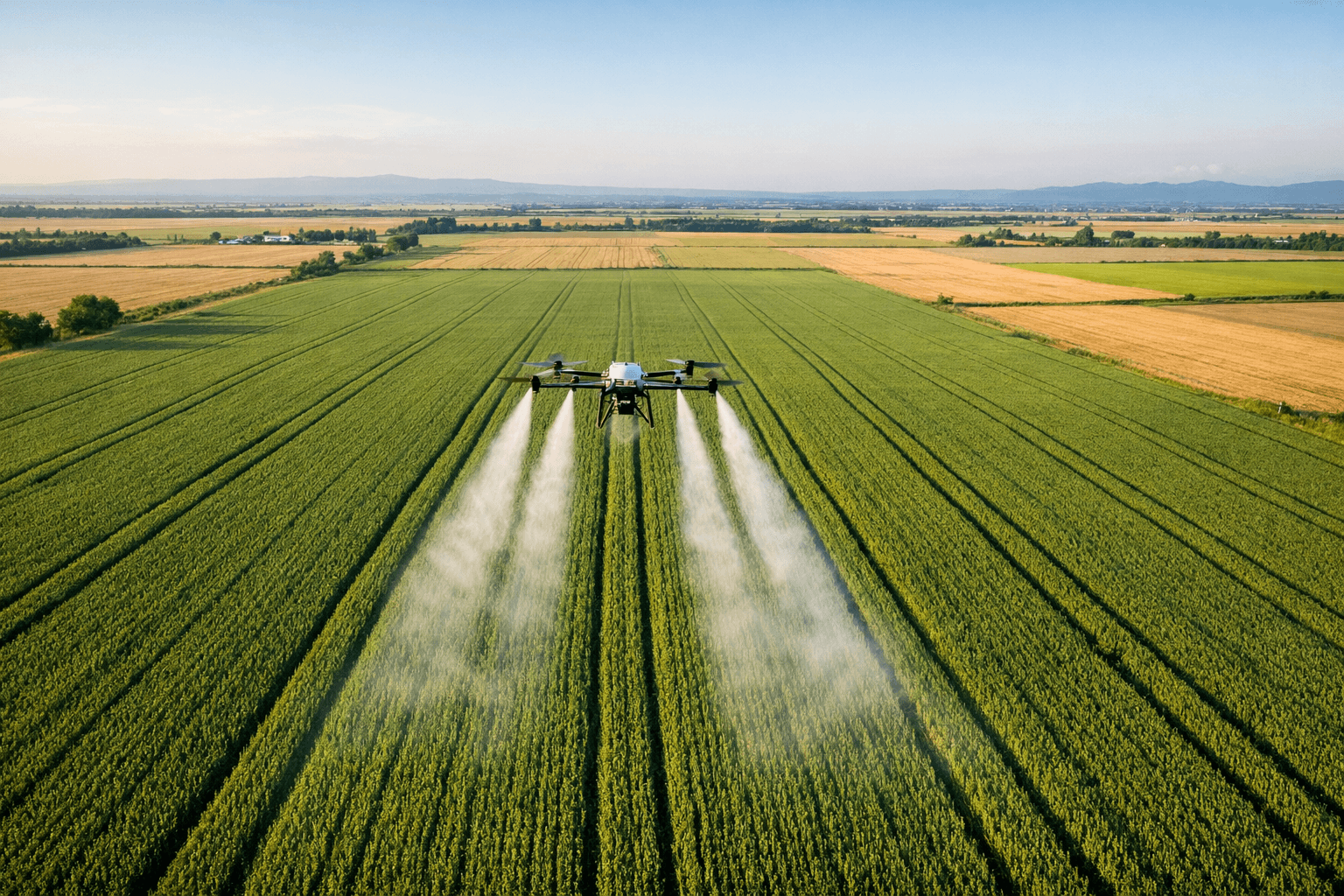
- Crop spraying – herbicides, fungicides, insecticides and foliar fertilisers
- Spreading granular fertilisers – uniform fertilisation of large areas
- Field mapping – creating detailed maps with multispectral cameras
- Crop monitoring – early detection of diseases, weeds and stress
- Seeding – spreading seeds in difficult-to-reach terrain
Why Drones Are the Most Accessible Technology for Bulgarian Farmers
Unlike expensive autonomous tractors or complex IoT systems, agricultural drones offer many advantages that make them ideal for Bulgarian conditions:
- No own investment required – you can use professional drone services without buying equipment
- Immediate results – the technology is applied straight away, without lengthy implementation
- Adaptability – drones operate on all types of terrain, including hilly and difficult-to-reach areas
- Economy – they reduce preparation consumption by 20–30% thanks to precise application
- Environmental compliance – they meet EU requirements for sustainable farming
Find out how agri drones are used in practice in Bulgarian agriculture.
Satellite Imagery and NDVI Analysis
What NDVI Is and Why It Matters
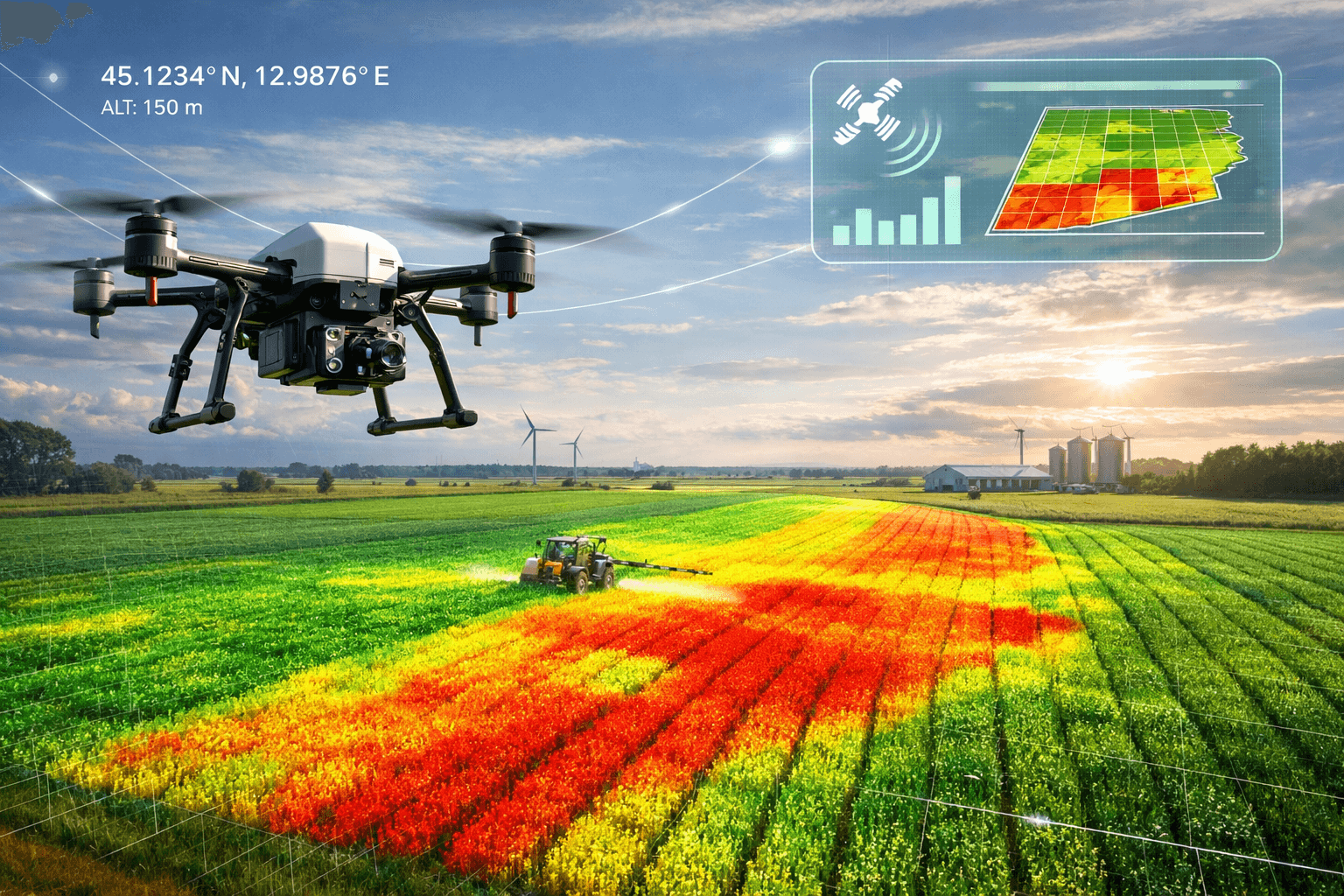
NDVI (Normalized Difference Vegetation Index) is an index that measures plant health by analysing reflected light. Healthy plants reflect more infrared light, while diseased or stressed ones reflect less. Satellite images provide NDVI maps of entire fields, showing:
- Zones with well-developed plants (green)
- Zones with stress or disease (yellow/red)
- Bare or untreated sections
Practical Application
Farmers can use NDVI data to:
- Identify problem zones before damage becomes visible to the naked eye
- Plan differential fertilisation and spraying
- Assess the effectiveness of treatments performed
- Forecast yields with greater accuracy
The combination of satellite data and drone spraying is extremely powerful – the NDVI map shows where the problem is, and the drone applies the solution precisely where it is needed.
IoT Sensors in Agriculture
A Network of "Smart" Devices in the Field
The Internet of Things (IoT) is becoming increasingly active in agriculture. Small, autonomous sensors scattered throughout the field collect real-time data on:
- Soil moisture – at different depths
- Soil and air temperature – for disease forecasting
- Rainfall amount – accurately for the specific field
- Nutrient level – pH, nitrogen, phosphorus, potassium
- Wind speed and direction – critical for spraying
Benefits for Farmers
IoT sensors enable decision-making based on real data rather than guesswork. For example, instead of irrigating on schedule, you irrigate when the sensor shows that soil moisture has dropped below the optimal level. This saves water, energy and improves crop health.
Artificial Intelligence and Machine Learning
AI in Agriculture
Artificial intelligence (AI) processes vast volumes of data from sensors, drones, satellites and meteorological stations to generate useful recommendations:
- Disease forecasting – AI models analyse meteorological data and historical records to predict the appearance of fungal diseases days before the first symptoms
- Fertilisation optimisation – algorithms calculate exact fertiliser amounts for each zone of the field
- Weed recognition – drone cameras recognise weeds and treat only the affected sections
- Yield forecasting – models predict expected yields with over 90% accuracy
AI in Drones
Modern agricultural drones like the DJI Agras T50 already integrate elements of AI – terrain recognition, automatic obstacle avoidance, adaptive spray speed based on vegetation density. This is a concrete example of accessible artificial intelligence working directly in the field.
Robotics in Agriculture
Autonomous Machines
Robotics is the logical continuation of automation. Autonomous tractors, harvesting robots, weeding robots – all of these already exist as working prototypes or commercial products. The main areas include:
- Autonomous tractors – operating without an operator, 24/7
- Precision weeding robots – recognise and remove weeds mechanically, without herbicides
- Harvesting robots – use computer vision to recognise ripe fruits
- Fully autonomous drones – execute missions without human intervention
Agricultural drones are essentially flying robots and represent one of the most mature forms of robotics in agriculture. They are already available for mass use, unlike the more complex ground robots.
VRA – Variable Rate Application
What VRA Is
VRA (Variable Rate Application) is a technology where the application rate of fertiliser, preparation or seed automatically changes based on the needs of the specific section of the field. Instead of a uniform dose everywhere, the system applies more where needed and less where it is not.
How It Works in Practice
- Data collection – via satellite imagery, NDVI analysis, soil samples
- Application map creation – software generates a map with different zones and corresponding doses
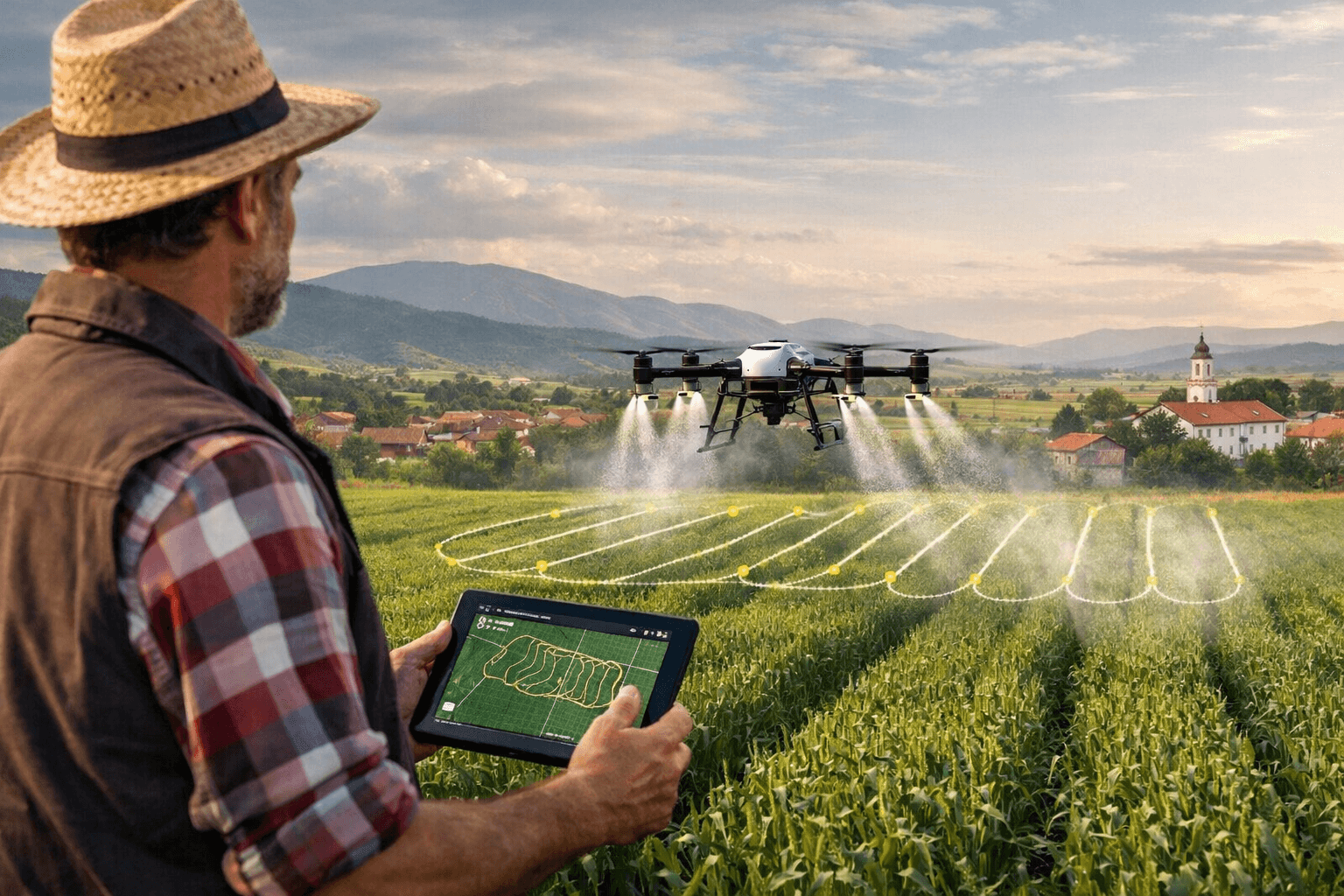
- Execution – the machine (tractor or drone) automatically adjusts the rate according to the map
The DJI Agras T50 supports VRA mode, automatically adjusting the solution flow rate according to a pre-loaded map. This means that the technology for precision spraying is already accessible to Bulgarian farmers without the need for expensive ground systems.
EU Green Deal and Sustainable Agriculture
EU Green Deal Requirements
The European Green Deal sets ambitious targets for agriculture:
- 50% reduction in pesticide use by 2030
- 20% reduction in fertilisers
- 25% of agricultural land to be managed organically
- 50% reduction in antimicrobials
How Technologies Help
Precision agriculture is key to achieving these goals without reducing yields. Drones are particularly useful because:
- They apply preparations only where needed (VRA)
- They reduce losses from drift thanks to low flying altitude
- Early detection of problems allows smaller doses with timely intervention
- They document every operation for traceability and accountability
The Future of Agricultural Technologies in Bulgaria
Bulgaria has enormous potential for adopting modern agricultural technologies. The country has extensive arable land, educated young farmers and access to European funding.
Regional Development of Agri-Technologies
The Thracian Plain – the areas around Plovdiv, Stara Zagora and Pazardzhik – leads in the adoption of drone technologies thanks to the diversity of crops: vineyards, orchards, vegetables and cereals. In the Haskovo area, modern technologies are applied to cotton, tobacco and oilseeds. Dobrudzha with its vast cereal areas is ideal for VRA fertilisation and autonomous drone operations over large areas.
The main trends that will shape the future of Bulgarian agriculture:
- Mass adoption of drones – more and more farms in Thrace and Dobrudzha are switching to drone spraying
- Data integration – combining information from drones, sensors and satellites for better decisions
- Automation of routine operations – reducing dependence on manual labour
- Digital farming platforms – software for farm management
Agricultural drones are already here and prove their value daily on Bulgarian fields. They are the fastest and most accessible way for farmers to take a step towards the technological future.
Frequently Asked Questions
What are the most important technologies in modern agriculture?
The most important technologies include GPS navigation with RTK correction, agricultural drones for spraying and monitoring, IoT sensors for real-time data from the field, satellite NDVI analysis and VRA (variable application rate). Agricultural drones are the most accessible entry point for Bulgarian farmers.
How is artificial intelligence used in agriculture?
AI analyses data from sensors, drones and satellites to forecast diseases days before the first symptoms, optimise fertilisation zone by zone, recognise weeds for spot treatment and forecast yields with over 90% accuracy. The DJI Agras T50 already integrates AI elements for adaptive spraying.
What is the return on investment in a drone for agriculture?
When hiring a drone service, the return is immediate – you save 20–30% on preparations and eliminate losses from trampling (3–5% of yield). For a farm of 1,000 decares, the savings exceed the cost of the service from the very first season. See the advantages of drones in agriculture.
How does precision agriculture differ from traditional farming?
Traditional agriculture treats the entire field uniformly, while precision agriculture analyses differences zone by zone and applies an individual approach. The result: 10–30% fewer fertilisers, 15–25% fewer preparations and 5–15% higher yields.
What is digital agriculture and how do I get started?
Digital agriculture is the integration of digital technologies on the farm – from GPS navigation and drones to farm management software. The easiest way to get started is to request a free consultation with AirAgro – we will analyse your farm's needs and propose a concrete plan.
Get Started with Technology Today
You don't need to invest millions to modernise your farm. With AirAgro's professional drone services you can immediately benefit from precision spraying with the DJI Agras T50 – without your own equipment, without training, without risk. We serve farms in Plovdiv, Stara Zagora, Pazardzhik, Haskovo, Dobrudzha and the entire Thracian Plain.
🚁 Request a free consultation and farm inspection – our team will prepare a personalised treatment plan and organise a drone demonstration directly on your field.
📞 Call +359 884 242 406 or complete the form at airagro.bg – take the first step towards modern agriculture today!