How Agricultural Drones Work – A Complete Guide
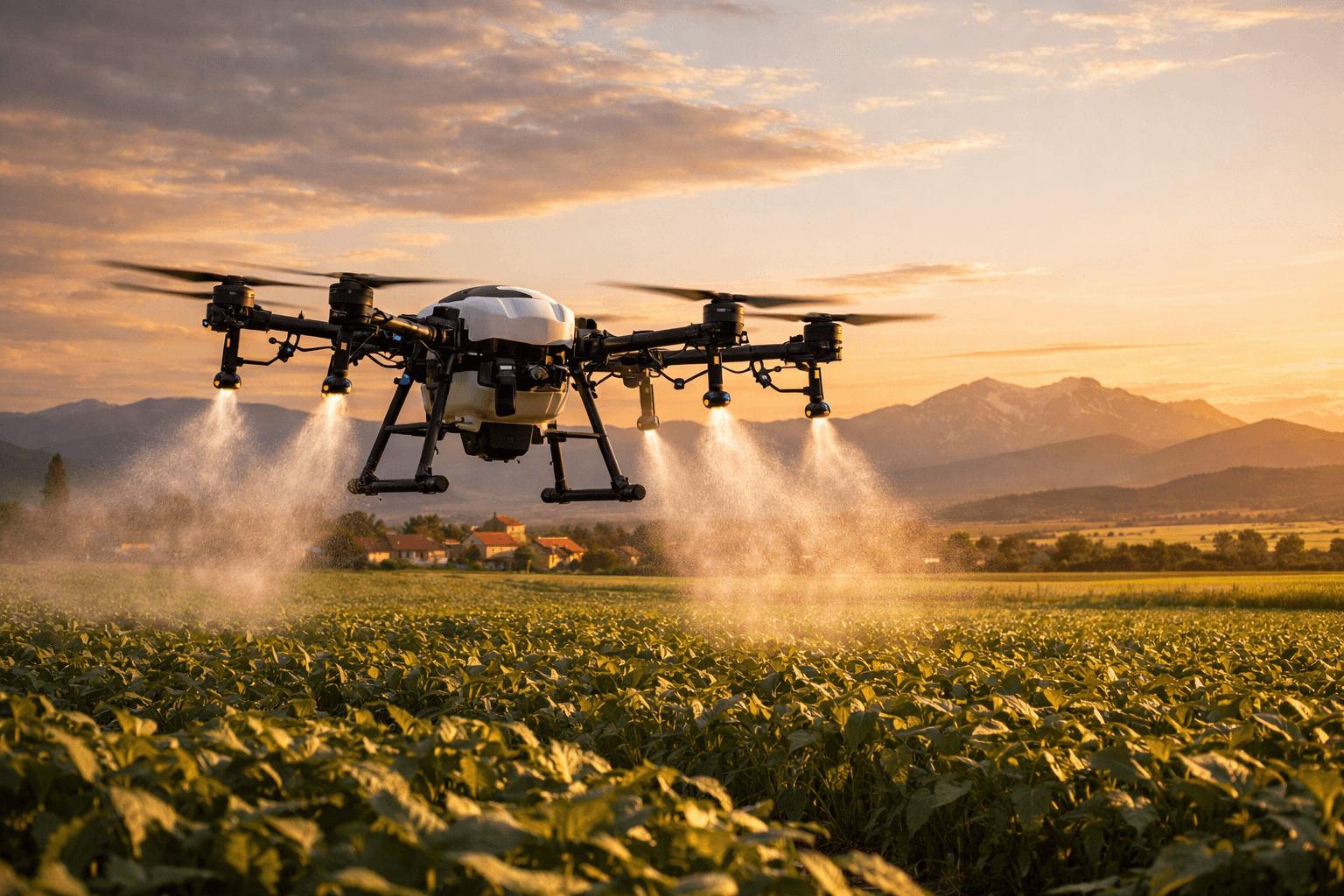
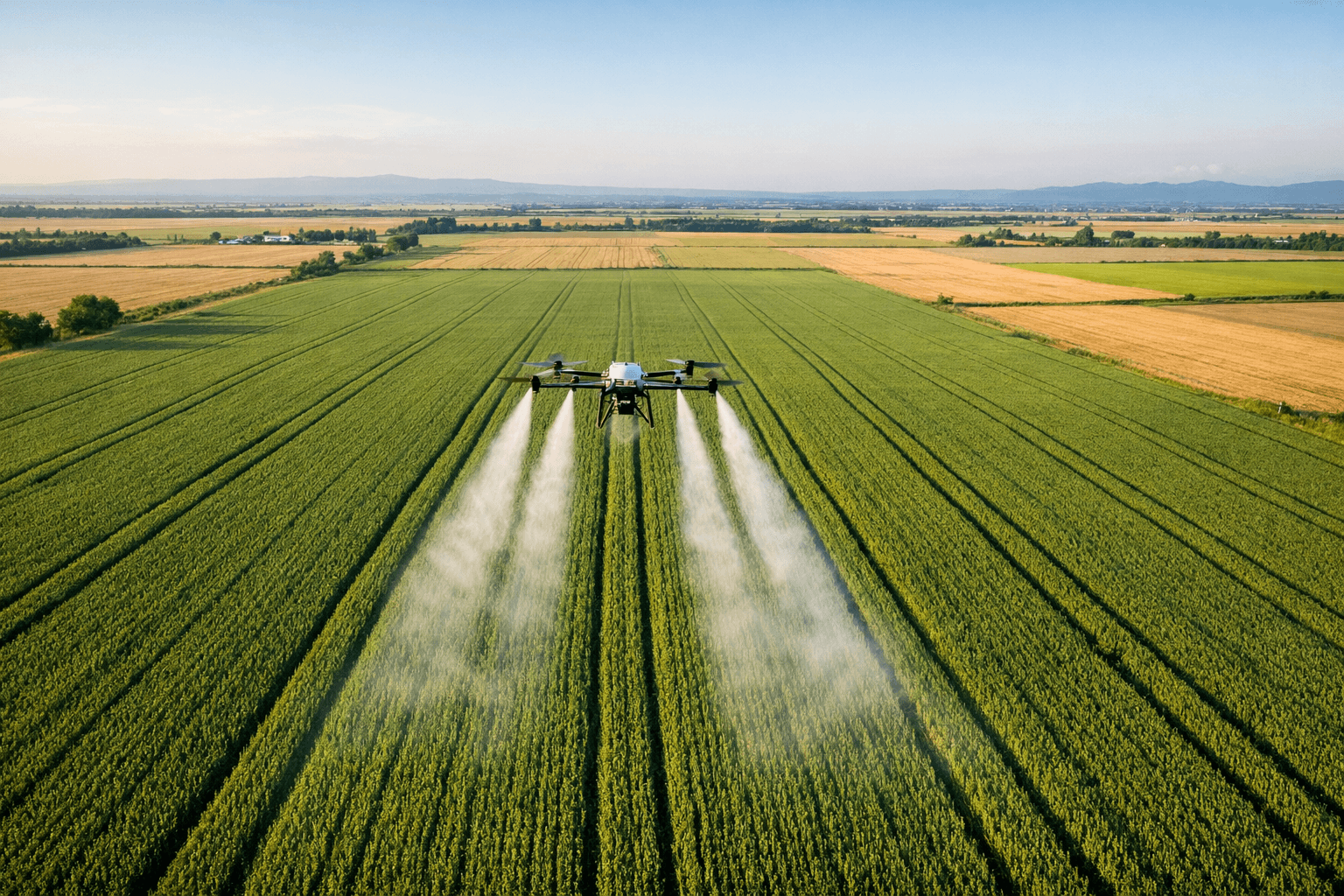
Agricultural drones are no longer the future – they are the present. But the question how agricultural drones work remains unclear for many farmers. In this complete guide we will examine the technology behind agri drones – from the frame and motors, through the spraying system, to GPS navigation and autonomous flight. We will use the DJI Agras T50 as our example – one of the most widely used professional agricultural drones in the world and in Bulgaria.
How Are Agricultural Drones Different from Hobby Drones?
If you have seen a small photo drone, you might think an agricultural drone is something similar. The truth is the differences are enormous – much like the difference between a passenger car and a combine harvester.
Key Differences
| Characteristic | Hobby drone | Agricultural drone (DJI Agras T50) | | --------------- | ------------- | ------------------------------------ | | Weight | 0.5–2 kg | 50+ kg (with full tank) | | Payload | Camera | 40 litres liquid or 50 kg fertiliser | | Flight time | 20–30 min | 10–15 min (at full load) | | Treatment width | – | 7–11 metres | | Navigation | GPS | RTK GPS (centimetre accuracy) | | Price | 500–3,000 BGN | 100,000+ BGN |
An agricultural drone is a specialised flying machine designed to disperse preparations or fertilisers with exceptional precision. Let us examine each component in detail.
Frame and Motors – the Foundation of the System
Frame
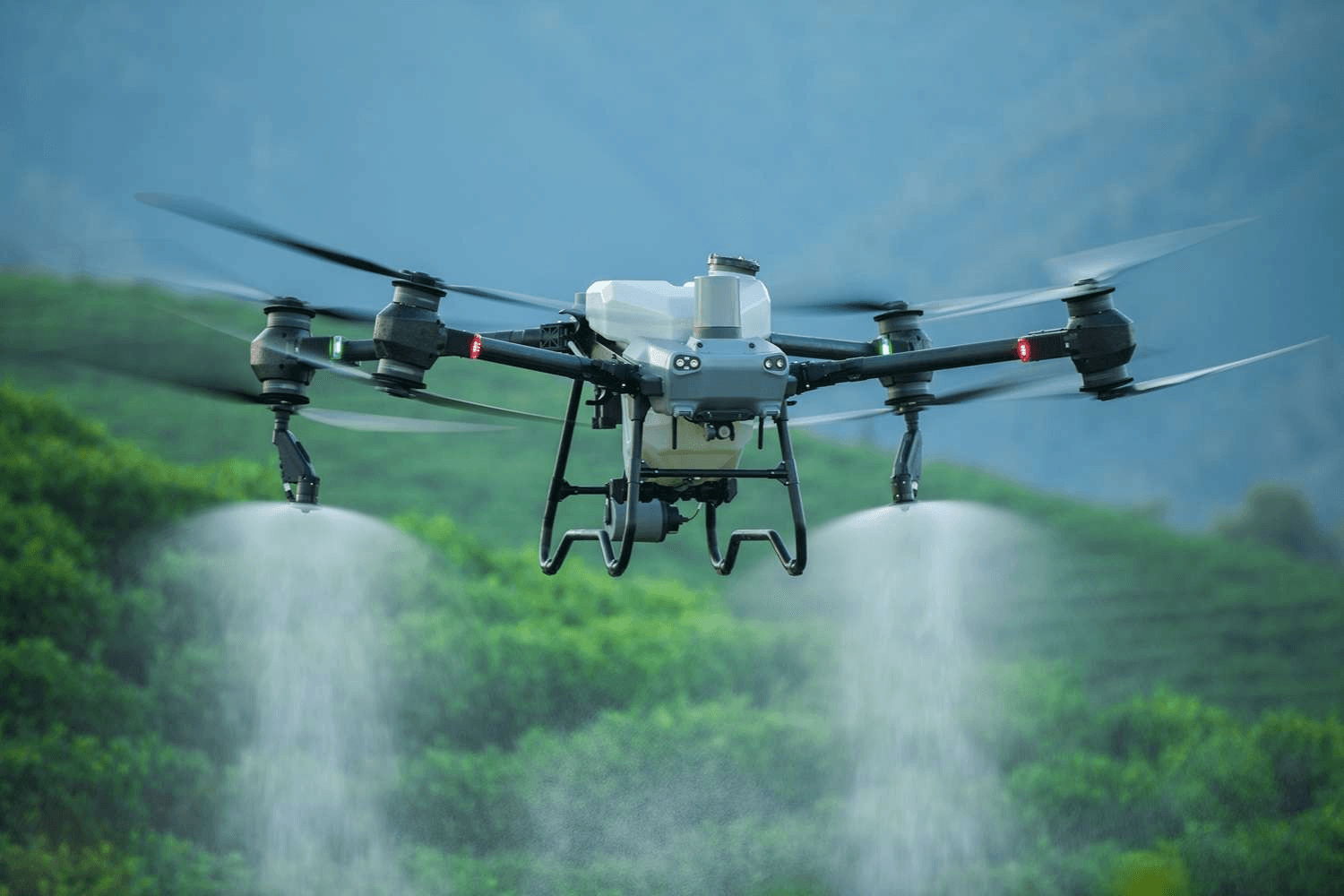
The DJI Agras T50 frame is made from carbon composite materials – light but exceptionally strong. It is designed to withstand vibrations, moisture from preparations and frequent landing/take-off cycles. The drone has four arms (quadcopter), each of which can be folded for easier transport.
Motors and Propellers
The DJI Agras T50 uses four brushless electric motors with high torque. Each motor drives a dual coaxial propeller (i.e., two propellers one above the other, rotating in opposite directions). This provides:
- Powerful lift – the drone lifts up to 50 kg of payload
- Stability in wind – works in winds up to 6 m/s
- Downward airflow – helps penetration of preparation into the leaf mass
The downward flow from the propellers is a key element – it literally "presses" the fine droplets downward, ensuring better coverage of the underside of leaves where pests often hide.
Spraying System – the Heart of the Agri Drone
The spraying system is what distinguishes an agricultural drone from any other aircraft. In the DJI Agras T50 it includes several key components.
Tank (40 litres)
The tank is positioned in the centre of the drone for optimal balance. With a volume of 40 litres it allows treatment of 20–40 decares per fill (depending on the spraying rate). Filling takes about 1 minute.
Centrifugal Nozzles
The DJI Agras T50 uses dual centrifugal nozzles that differ significantly from the conventional hydraulic nozzles of tractor sprayers.
How they work:
- Liquid is supplied under pressure to a spinning disc
- The disc rotates at 10,000–15,000 revolutions per minute
- Centrifugal force disperses the liquid into fine, uniform droplets
- Droplet size can be adjusted (60–300 microns)
The advantage is an exceptionally uniform droplet size, which means better coverage and less wind drift. The operator can adjust droplet size according to the specific preparation and weather conditions.
Pump and Flow Control
The system includes a precise peristaltic pump that accurately controls the exact amount of liquid released every second. Flow is regulated automatically relative to the drone's speed – if the drone slows (for example at a turn), flow decreases to avoid overdosing.
GPS and RTK Navigation – Precision to Centimetres
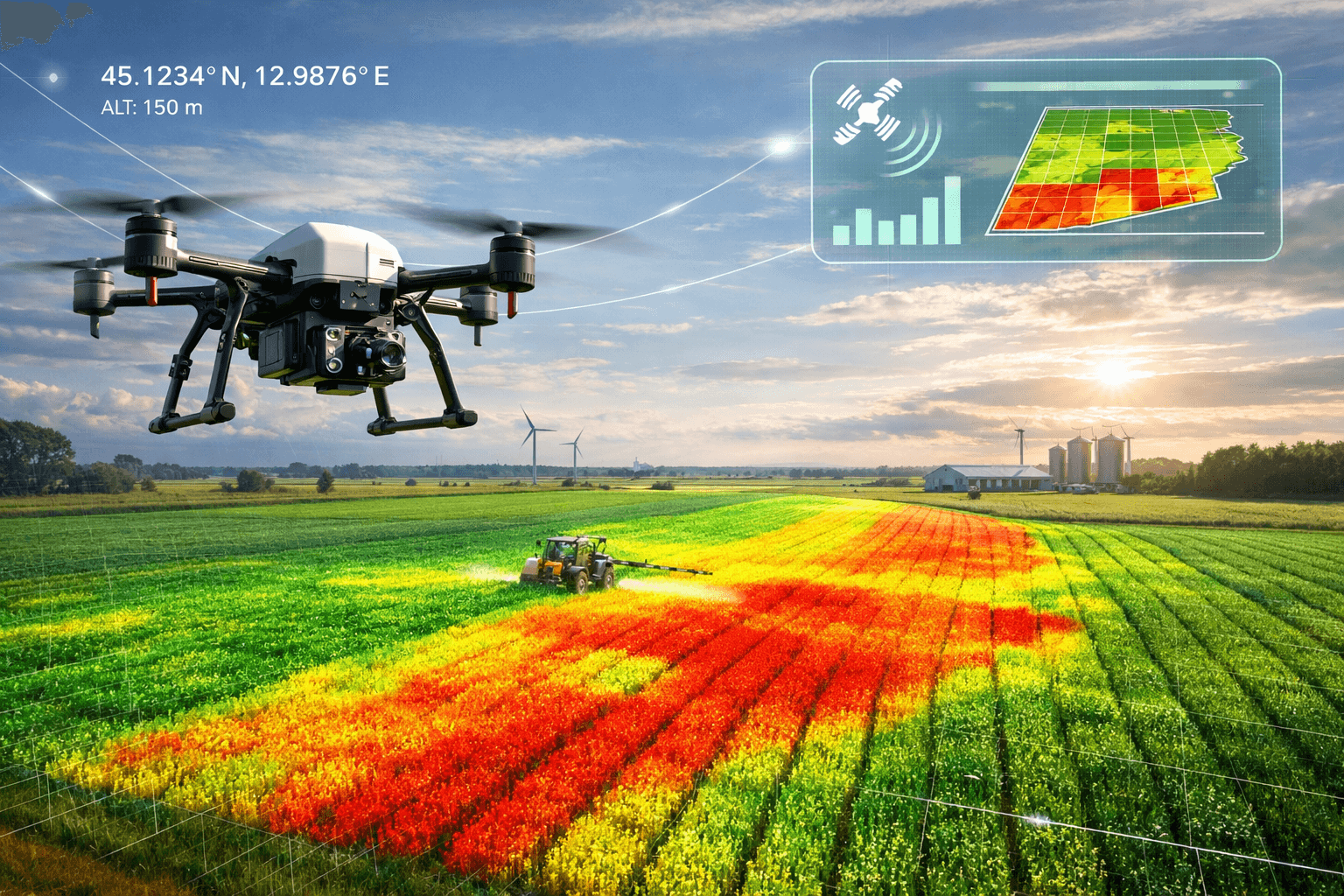
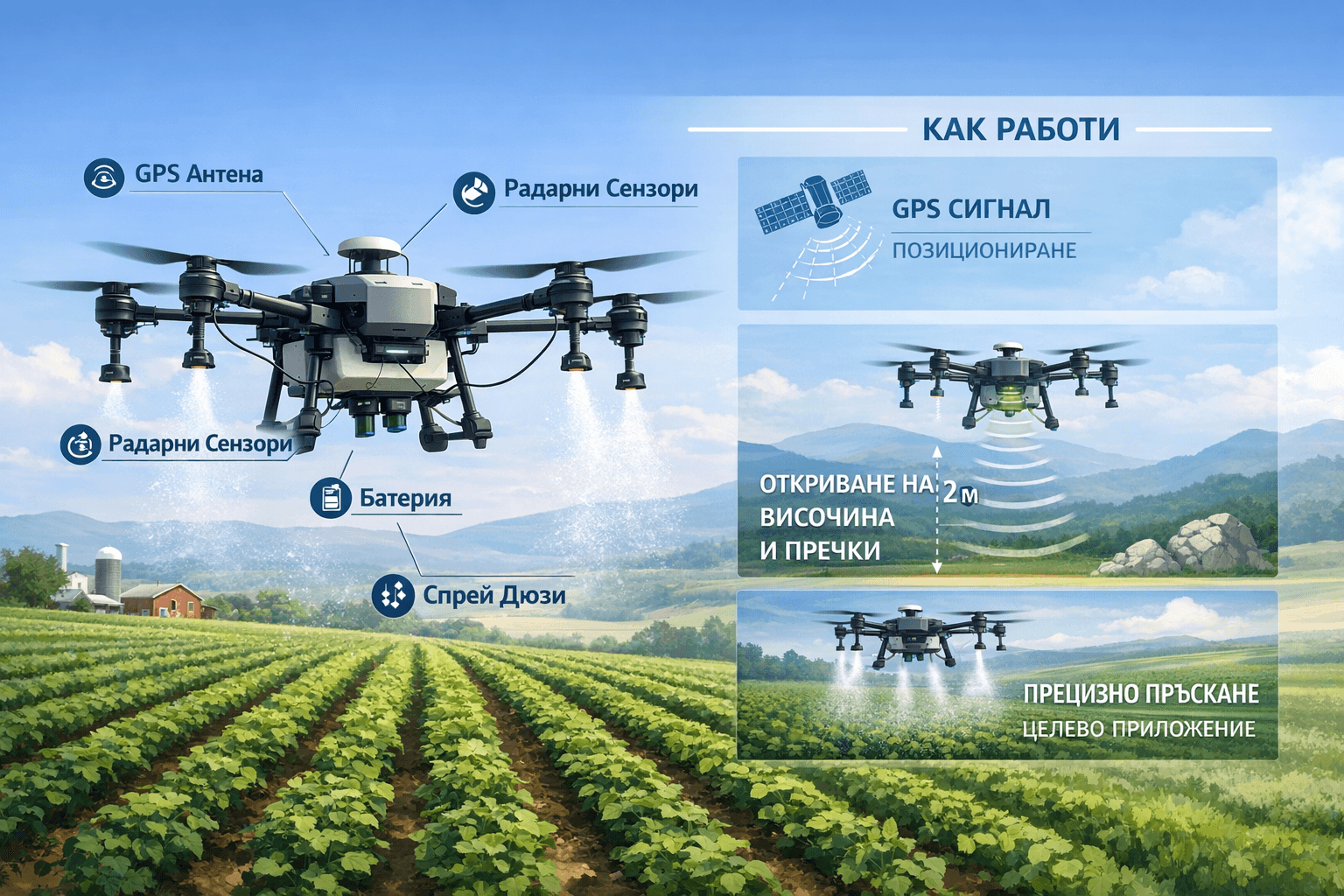
Navigation is perhaps the most important technology in modern agricultural drones. The DJI Agras T50 uses a dual GNSS system (GPS + GLONASS + Galileo + BeiDou) in combination with RTK correction.
What Is RTK?
RTK (Real-Time Kinematic) is a technology for precision positioning. Standard GPS has accuracy of 1–3 metres, which is insufficient for agriculture. RTK adds a ground base station that sends corrections to the drone in real time. The result:
- Positioning accuracy: 1–2 centimetres
- Perfect overlap of strips (no gaps and no double spraying)
- Repeatability – the drone flies along exactly the same routes with each treatment
This precision is the foundation of modern agriculture and is the key reason drones achieve 20–30% savings on preparations compared to traditional spraying.
Terrain-Following Radar
The DJI Agras T50 is equipped with dual phased radar that constantly scans the terrain below and in front of the drone. This radar performs two critical functions:
1. Maintaining Constant Height
The drone flies at 2–3 metres above the crops. If the terrain is not flat (hills, valleys), the radar automatically corrects the height. This guarantees uniform application of preparation, even in hilly terrain and vineyards.
2. Obstacle Avoidance
The radar detects trees, poles, electricity lines and other obstacles. The drone automatically avoids them or stops if it cannot find a safe route. This is critical for safety during autonomous flight.
Cameras and Sensors
In addition to the radar, the DJI Agras T50 has:
- FPV camera – front view for the operator (1080p video stream)
- Binocular visual system – additional obstacle avoidance system
- Liquid level sensor – monitors how much preparation remains in the tank
- IMU (Inertial Measurement Unit) – monitors the drone's orientation in space
All these sensors work together to provide stable and safe flight, even in complex conditions.
Autonomous Flight – How the Drone Flies by Itself
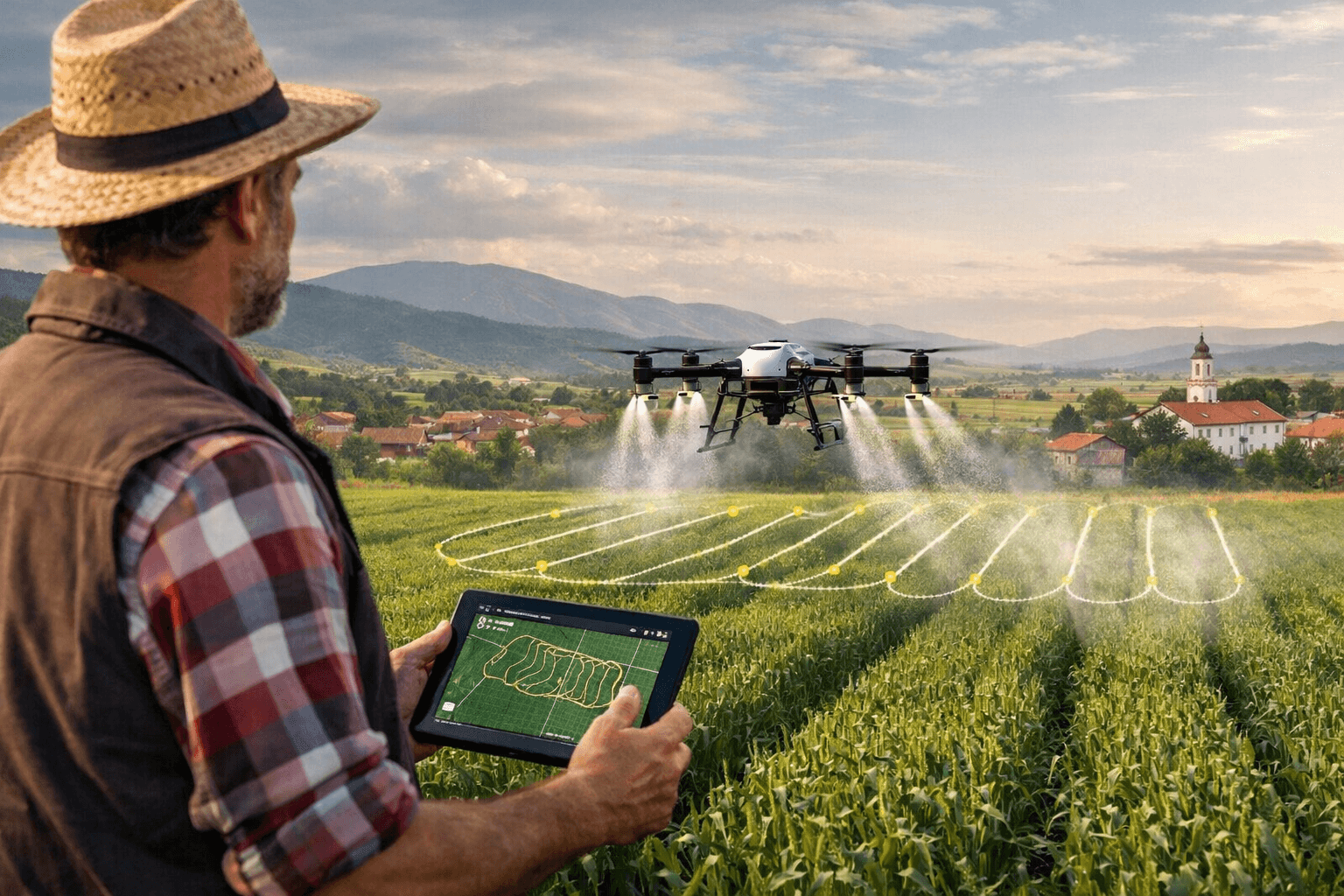
One of the most impressive features of modern agricultural drones is autonomous flight. Here is how the process works step by step:
Step 1: Field Mapping
The operator marks the field boundaries by:
- Flying the drone around the perimeter
- Entering GPS coordinates
- Importing a map from an application
Step 2: Route Planning
The software automatically generates the optimal spraying route – parallel lines with precisely defined strip width. The operator sets:
- Flight height
- Speed
- Spraying rate (litres/decare)
- Droplet size
Step 3: Autonomous Execution
The drone takes off and follows the route completely autonomously. It automatically:
- Switches spraying on and off at precise points
- Regulates speed and flow
- Avoids obstacles
- Monitors battery level and preparation level
Step 4: Automatic Recharging
When the battery or preparation runs out, the drone automatically returns to the loading point. After battery swap and tank refill, it continues exactly from where it stopped.
Management Software
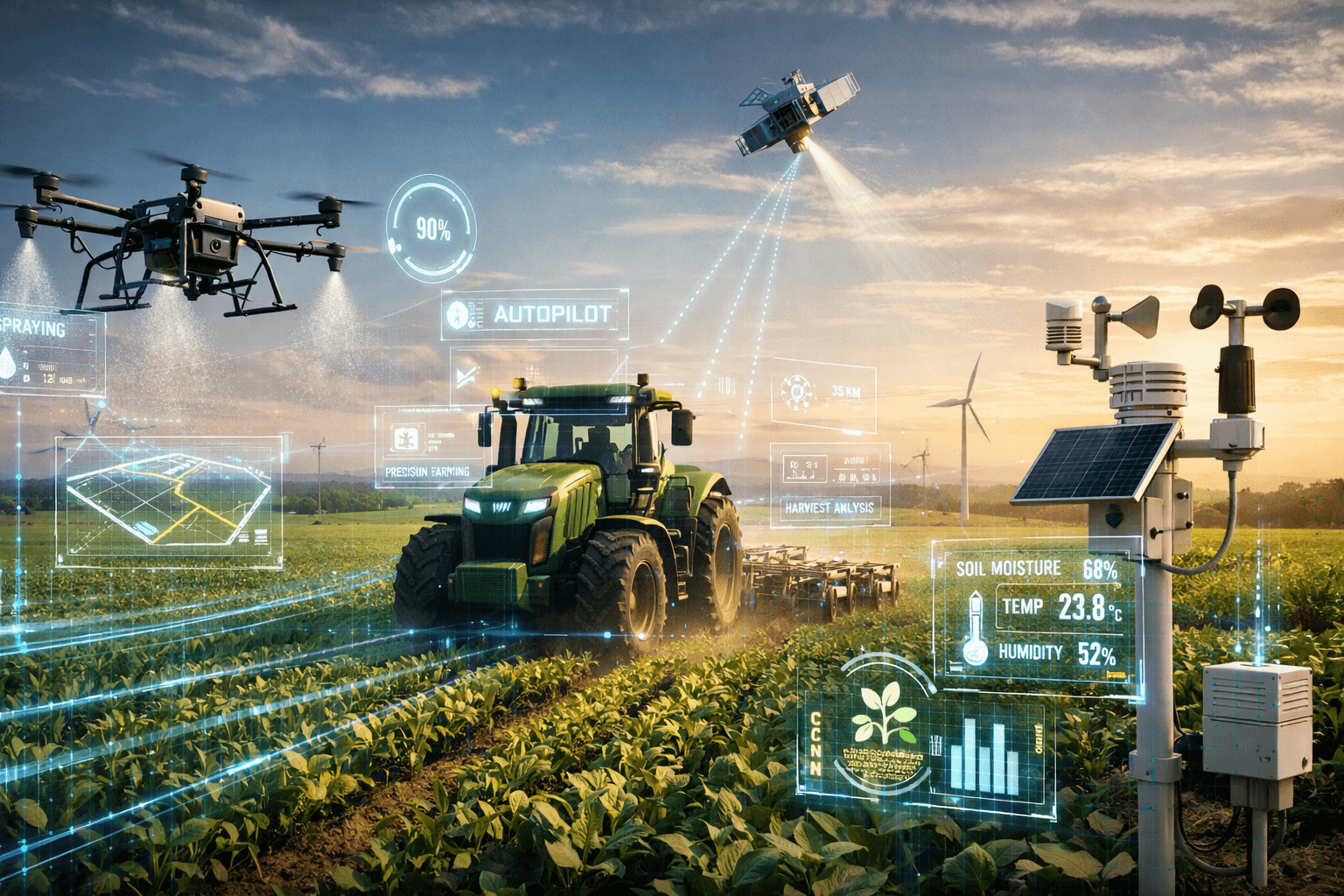
The DJI Agras T50 is operated via the specialised DJI Agras software (mobile app and controller). The software offers:
- Mission planning – with route visualisation on a satellite map
- Real-time monitoring – speed, height, flow, remaining preparation
- Operations log – date, time, treated area, used quantity
- Multi-drone management – one operator can control several drones simultaneously
- Reporting – automatically generated reports for performed treatments
This documentation is especially important for BFSA inspections and when applying for subsidies from the State Fund Agriculture.
How the Spraying Process Works in Practice
The complete work process at spraying with the DJI Agras T50 can be seen in detail in the article on how an agricultural drone works. In brief:
- Preparation – operator arrives at the field, unfolds the drone (5 min)
- Mapping – marking the field boundaries (5–10 min)
- Settings – selecting spraying parameters (2 min)
- Loading – filling the tank with preparation (1 min)
- Take-off – drone begins the mission automatically
- Spraying – treating 20–25 dka in 10–12 minutes
- Return – battery swap, refilling the tank
- Repeat – until the entire field is treated
For a 100 dka field the entire process takes approximately 1–1.5 hours, including preparation.
Technological Advantages in Brief
How agricultural drones work in practice comes down to the intelligent combination of:
- Aviation engineering – powerful but lightweight construction
- Precision agronomy – controlled preparation application
- Satellite navigation – centimetre accuracy
- Artificial intelligence – autonomous flight and adaptive behaviour
- Sensor technology – continuous condition monitoring
Everything works in synchrony to provide effective and precise crop protection.
What This Means for Bulgarian Farmers
Understanding the technology behind agricultural drones helps farmers make informed decisions. There is no need to buy your own drone – you can hire a professional drone spraying service and take advantage of all the benefits of the technology.
Agricultural drones are already working actively in the key agricultural regions of Bulgaria. Farmers in the Thracian Plain – around Plovdiv, Stara Zagora and Pazardzhik – benefit from drones for spraying vineyards, orchards and vegetable crops. In the Haskovo area drones are applied successfully to cotton and tobacco, while in Dobrudzha large grain areas are treated quickly and effectively with the DJI Agras T50. Regardless of the region, the technology ensures equally high treatment quality.
Frequently Asked Questions
Do agricultural drones fly autonomously or with an operator?
Agricultural drones like the DJI Agras T50 fly autonomously along a pre-set route. The operator maps the field, sets the parameters (height, speed, spraying rate) and the drone executes the mission independently. An operator is present in the field for monitoring and recharging, but does not manually control the flight.
How long does the agricultural drone battery last?
The DJI Agras T50 has intelligent batteries providing 10–15 minutes of flight at full load of 40 litres. A battery swap takes under 30 seconds, and with a set of 6–8 batteries the drone can work continuously all day. For more details see the DJI Agras T50 specifications.
What is the GPS accuracy of agricultural drones?
The DJI Agras T50 uses RTK navigation with ±2 centimetre accuracy. This is significantly more precise than standard GPS (2–3 metres) and guarantees perfect overlap of strips without gaps and double spraying. RTK correction is provided by a ground base station.
What payload can an agricultural drone carry?
The DJI Agras T50 carries 40 litres of liquid solution or 50 kg of granular fertiliser. One full tank treats 20–40 decares depending on the spraying rate. Loading takes under 2 minutes, which minimises downtime.
In what weather conditions can a spraying drone work?
The DJI Agras T50 works at temperatures from -10°C to +45°C and winds up to 6 m/s (around 20 km/h). The drone has IP67 protection against dust and water, so light rain is not a problem. Spraying in strong wind above 6 m/s is not recommended, as this can carry fine droplets outside the target zone.
Want to see how the DJI Agras T50 works on your field? The AirAgro team offers a free drone demonstration for farms in Plovdiv, Stara Zagora, Pazardzhik, Haskovo and Dobrudzha. We will carry out a farm inspection, demonstrate in practice how agricultural drones work and prepare an individual treatment plan with real data on effectiveness and coverage.
📞 Call today for a free consultation and request a demonstration at airagro.bg!