Why Bulgarian Forests Need Urgent Protection
Bulgarian forests cover nearly 4 million hectares – over 35% of the country's territory. The Rhodopes, Balkan Range, Middle Balkan, Rila and Strandzha are home to valuable coniferous and broadleaved stands that form the backbone of our ecosystems. Over the last decade, however, these forests are facing a growing wave of pests and diseases, amplified by climate change and drying.
Pine processionary (Thaumetopoea pityocampa), bark beetles from the genus Ips typographus and phytopathogenic fungi are causing mass tree dieback. According to data from the Executive Forest Agency, in 2024 alone over 38,000 hectares of coniferous forests in Southern and Southwestern Bulgaria were affected. Traditional control methods are proving slow, expensive and difficult to apply in mountainous terrain. This is exactly where forest spraying with a drone offers a modern and effective solution.
The Problem: Pests and Pathogens That Destroy Forests
Pine Processionary (Thaumetopoea pityocampa)
The pine processionary is one of the most destructive pests of coniferous forests in Bulgaria. Caterpillars feed on the needles of pine, cedar and spruce, and in mass infestation can defoliate entire stands within a single season. Besides direct damage to trees, the urticating hairs of the larvae pose a serious health risk for people and animals – they cause allergic reactions, dermatitis and respiratory problems.
In the Rhodopes and along the Southern Black Sea coast, the pine processionary population is growing at 15–20% per year, with warm winters further accelerating pest development.
Bark Beetles – Ips typographus and Related Species
The typographer bark beetle (Ips typographus) is the main xylophage on spruce in Bulgaria. It attacks trees weakened by drought, storm or other stress factors and in mass proliferation can destroy hundreds of hectares of forest in a single summer season. The Balkan Range and the higher parts of the Rhodopes are particularly vulnerable, as they hold the largest spruce stands.
Phytopathogenic Fungi
Fungal pathogens such as Diplodia sapinea, Dothistroma septosporum and Heterobasidion annosum cause brown tip blight, red band needle blight and root rot. These diseases lead to gradual weakening and death of trees, creating conditions for subsequent attack by bark beetles and other secondary pests.
Why Traditional Methods Fail
Ground Spraying – Limited Access
Forest territories in Bulgaria are characterised by difficult terrain – steep slopes, high relief variation and lack of road infrastructure. Ground sprayers physically cannot reach large areas of affected plots, especially in the Rhodopes, Middle Balkan and Strandzha. Even when access is possible, effectiveness is low – the jet only reaches 10–12 m in height, while many infected areas are in the crowns of trees 25–35 m tall.
Helicopter Spraying – Too Expensive
Aerial treatment by helicopter is effective for coverage, but prices start from 40–60 BGN/dka and above. With mosaic land ownership – typical of Bulgarian forests – treating individual small plots by helicopter is economically unjustifiable. The minimum area for a profitable helicopter flight is usually over 500 dka, which excludes small forest owners.
Fragmented Ownership
Forest territories in Bulgaria belong to state forestry enterprises, municipalities and thousands of private owners. Coordination between them is complex, and organising large helicopter treatment requires months of preparation. Meanwhile pests continue to spread.
How the Drone Solves the Problem: Forest Spraying with a Drone
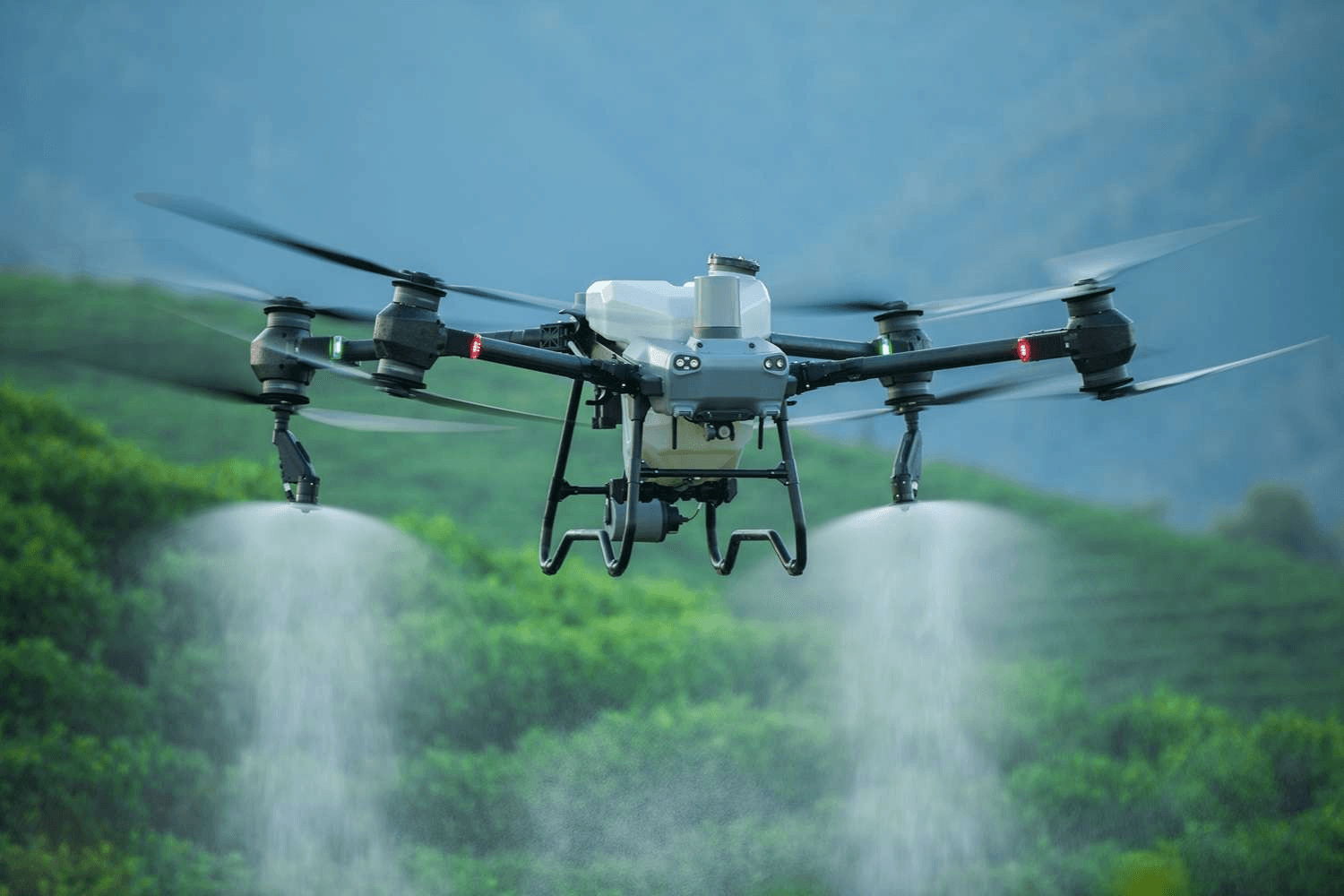
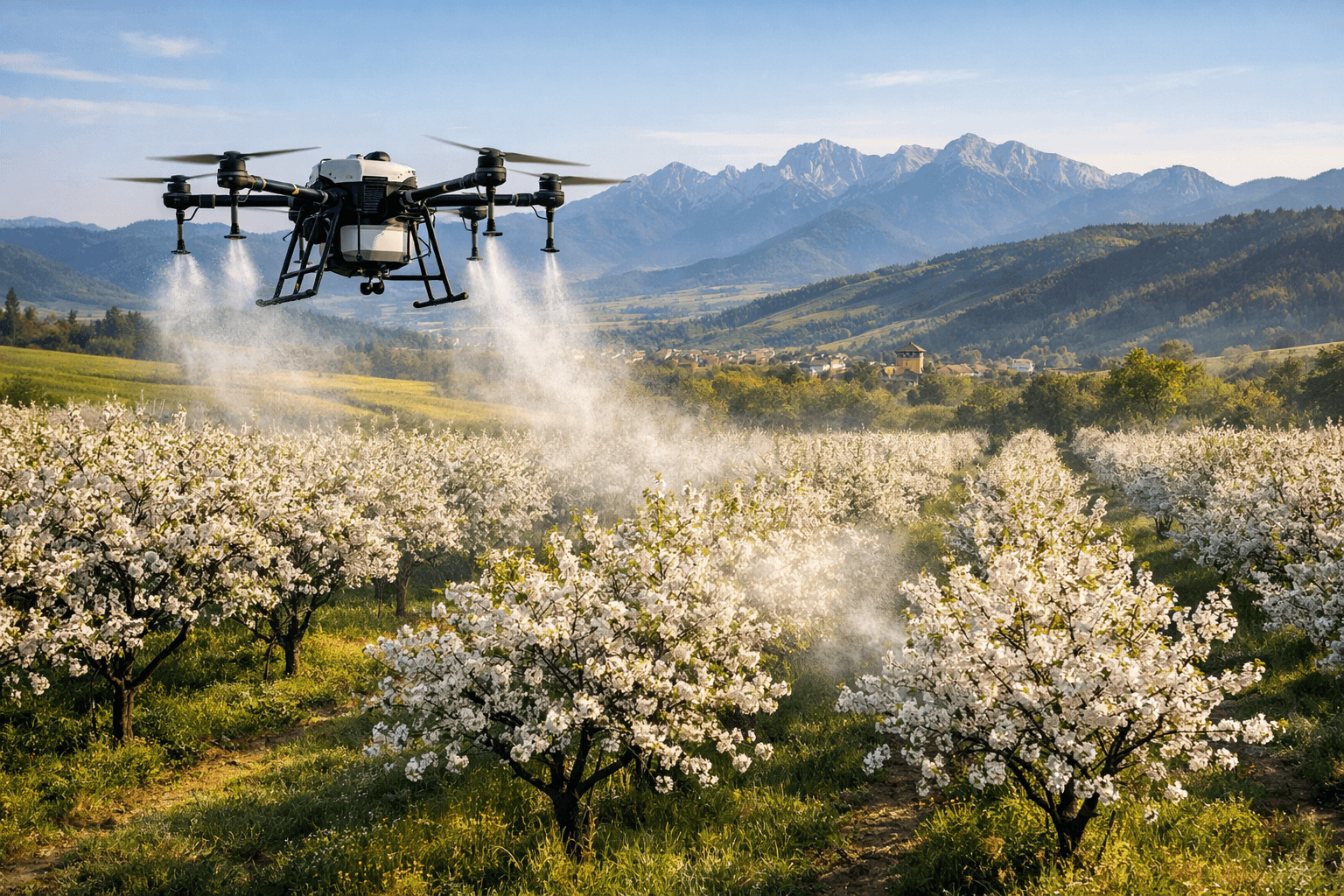
Forest spraying with a drone overcomes each of these limitations. The DJI Agras T50 agricultural drone is designed for work in complex terrain and offers a unique combination of precision, mobility and effectiveness.
Precise Targeting of Affected Plots
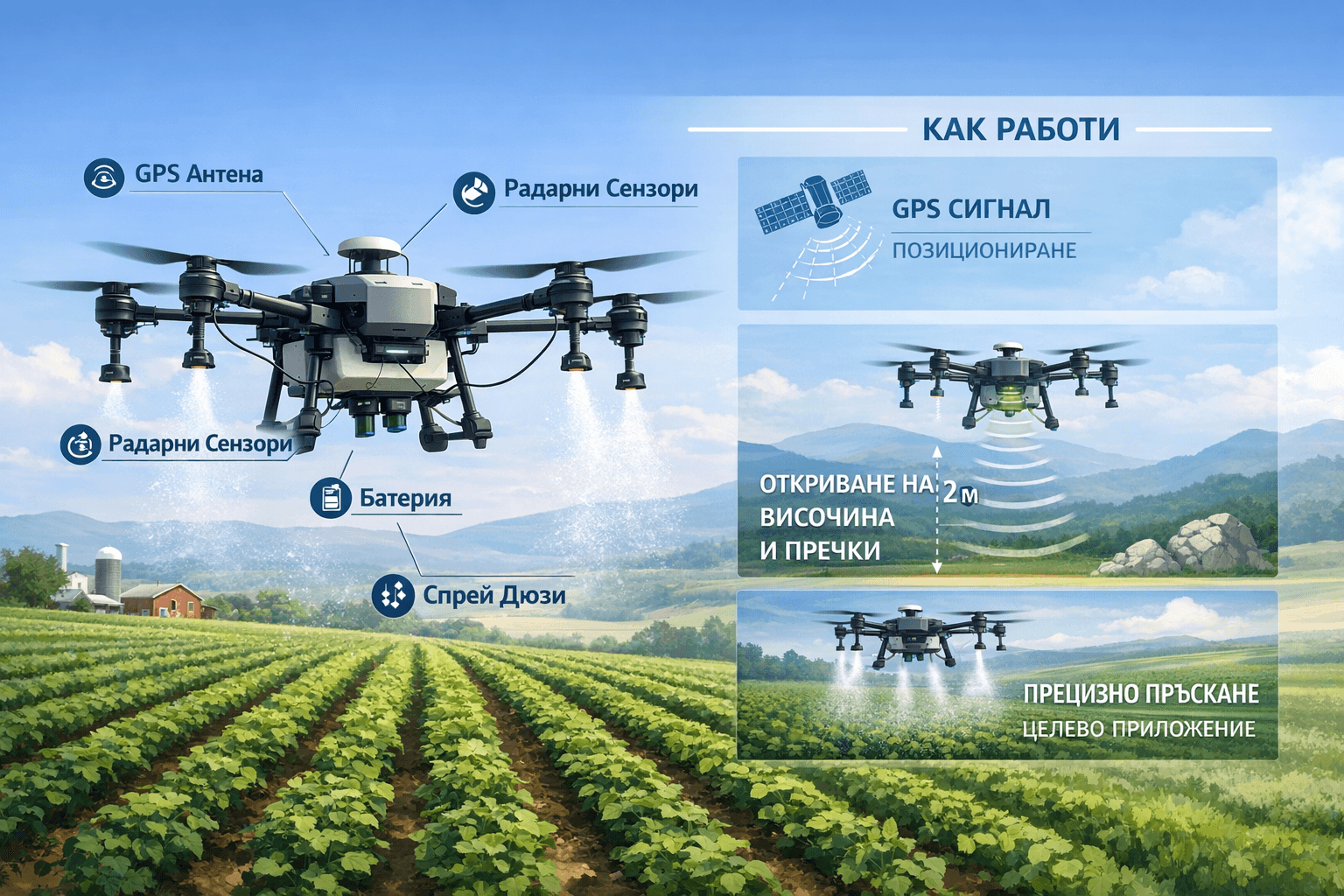
With GPS flight plans and RTK correction with accuracy to 2 cm, the drone treats only the affected zones. There is no need to spray the entire forest – it is sufficient to identify the infestation foci and treat them precisely. This reduces preparation consumption by up to 40% compared to helicopter spraying and minimises impact on the surrounding ecosystem.
Access to Difficult Terrain
The DJI Agras T50 operates at heights of up to 30 m above tree crowns and can follow terrain relief automatically thanks to its radar sensors. Steep slopes, ravines and inaccessible ridges are no obstacle. The operator controls the flight from a safe position without entering dense forest.
Economic Effectiveness
The minimum area for drone treatment can be as small as 5–10 dka, making it ideal for private forest owners and municipal plots. The cost per decare is significantly lower than helicopter spraying, and the team's mobility allows treatment of several distant plots within a single working day.
Technical Parameters of the DJI Agras T50
- Tank: 40 L working solution
- Working width: up to 11 m effective strip
- Productivity: 50–70 dka/hour under forest conditions
- Navigation: RTK GNSS + visual radar for obstacle avoidance
- Nozzles: centrifugal ceramic with droplet size 80–200 µm, optimal for forest vegetation
Specific Applications and Treatments
Control of Pine Processionary
The optimal period for aerial treatment is September – November, when caterpillars are in early larval stages (L1–L3) and most vulnerable. Biological insecticides based on Bacillus thuringiensis var. kurstaki (Btk) are applied – they are selective and safe for beneficial entomofauna. For more advanced stages, plant-based insecticides (spinosad) or growth regulators (diflubenzuron) are used.
Control of Bark Beetles
With bark beetles the approach is complex. The drone is used for:
- Preventive spraying of at-risk stands with contact insecticides (deltamethrin, cypermethrin) in the period April–May, before the mass adult flight.
- Spreading pheromone attractants for a coordinated pheromone trap system.
- Mapping of infected zones using a multispectral camera mounted on the drone.
Fungicide Treatment of Forest Pathogens
Fungal infections require treatment with copper-containing fungicides (Bordeaux mixture) or systemic products in the period April–June, before mass spore development. The drone provides uniform coverage of crowns with a fine aerosol, which is critical for fungicide effectiveness.
Advantages of Drone Spraying over Other Methods
| Criterion | Ground spraying | Helicopter | Drone (DJI Agras T50) | | ----------------------- | --------------- | ------------ | --------------------- | | Terrain access | Limited | Good | Excellent | | Minimum area | 1 dka | 500+ dka | 5 dka | | Precision | Low | Medium | High (GPS/RTK) | | Preparation consumption | High | Medium | Low (ULV technology) | | Price per decare | Medium | High | Moderate | | Environmental impact | Medium | High (drift) | Low | | Mobilisation speed | Days | Weeks | Hours |
More about the general advantages of drones in crop protection can be found in our specialised article.
Regulatory Framework and Permits
Forest spraying with a drone in Bulgaria requires compliance with several regulatory requirements:
- Forestry management: Treatment is coordinated with the regional forest directorate and the corresponding state forestry enterprise. A forest protection plan approved by the Executive Forest Agency is required.
- BFSA (Bulgarian Food Safety Agency): Plant protection products used must be registered for the corresponding application. The operator must hold a certificate for working with PPP.
- GD "Civil Aviation Administration": Drone flights are performed in compliance with Ordinance No. 2 for unmanned aircraft systems. For forest zones outside populated areas, the "Specific" category applies for flights above 120 m altitude.
- Natura 2000: Treatment in protected zones requires a compatibility assessment with conservation objectives.
The AirAgro team holds all necessary licences and certificates and takes full responsibility for administrative coordination with institutions.
Service Areas
AirAgro performs forest spraying with drones across Southern and Central Bulgaria:
- Rhodopes – pine and spruce forests in the Smolyan, Devin, Kardzhali areas
- Middle Balkan – mixed forests near Pazardzhik, Plovdiv and Stara Zagora
- Strandzha – broadleaved and mixed stands in Burgas area
- Balkan Range – spruce forests in the high-altitude sections
- Thracian Plain – riparian forests and forest belts around Plovdiv, Haskovo and Stara Zagora
- Dobrudzha – forest stands and protective belts
Frequently Asked Questions
How much does forest drone spraying cost?
The price depends on area, terrain and treatment type. For plots over 50 dka the cost is significantly lower than helicopter spraying. For a specific offer contact us at +359 884 242 406 or through our services page.
Is drone spraying safe for the forest ecosystem?
Yes. We use ULV (ultra-low volume) technology with fine aerosol, which reduces drift outside the treated zone. Biological products based on Bacillus thuringiensis are selective and do not harm bees, birds and mammals. We observe all buffer zones around water sources and protected habitats.
Can the drone spray forests on steep mountain terrain?
Absolutely. The DJI Agras T50 is equipped with a radar sensor that automatically follows terrain relief. The drone operates effectively at slopes up to 45° and at elevations up to 2,500 m, covering virtually all forest zones in Bulgaria.
What is the minimum plot size for treatment?
There is no strict limitation – we can treat even individual infestation foci of 5–10 dka. This is the main advantage over helicopter spraying, which is only economical for large areas.
How long does it take to treat 100 dka of forest?
Under standard conditions the DJI Agras T50 treats 100 dka of forest in approximately 1.5–2 hours, including tank refilling and battery changes. Time may vary depending on terrain and stand density.
Protect Your Forests Today
Pests and diseases do not wait. Every lost season means thousands of dead trees and irreversible damage to the forest ecosystem. Forest spraying with a drone is the fastest and most precise way to protect your forests – whether you are a private owner, municipality or forestry enterprise.
Contact AirAgro:
- Phone: +359 884 242 406
- Website: airagro.bg
- Services: See the full list of services
Request a free consultation and terrain inspection. Our team will prepare an individual treatment plan tailored to the pest type, terrain and regulatory requirements.